

Protocols and Servers 2
Premium roomLearn about attacks against passwords and cleartext traffic; explore options for mitigation via SSH and SSL/TLS.
medium


To access material, start machines and answer questions login.
Set up your virtual environment
Imagine logging into your email from a coffee shop's open Wi-Fi network. Your email client connects to the mail server, sends your username and password, and retrieves your messages. If that connection uses a cleartext protocol, every piece of data, including your credentials, is visible to anyone else on the network. This room examines how that happens, what attackers do with that access, and how modern protocols prevent it.
The Protocols and Servers room covered the following protocols:
- Telnet
These protocols were designed decades ago when security was not a primary concern. They transmit data, including credentials, in cleartext. While the protocols themselves are still in use, modern deployments almost always use encrypted versions: HTTPS instead of HTTP, SFTP or FTPS instead of FTP, SMTPS instead of SMTP, and so on. Telnet has been largely replaced by for remote administration. Understanding the insecure versions helps you recognise misconfigurations, legacy systems, and the underlying mechanics that the secure versions build upon.
Servers implementing these protocols are subject to different kinds of attacks:
- Sniffing Attack (Network Packet Capture)
- Man-in-the-Middle () Attack
- Password Attack (Authentication Attack)
- Vulnerabilities
From a security perspective, you always need to think about what you aim to protect. Consider the security triad: Confidentiality, , and Availability (). Confidentiality refers to keeping the contents of communications accessible only to the intended parties. Integrity is the assurance that any data sent is accurate, consistent, and complete when reaching its destination. Availability refers to being able to access the service when you need it. Different parties will put varying emphasis on these three. For instance, confidentiality would be the highest priority for an intelligence agency. Online banking will put most emphasis on the integrity of transactions. Availability is of the highest importance for any platform making money by serving ads.
Knowing that you are protecting Confidentiality, Integrity, and Availability (CIA), an attack aims to cause Disclosure, Alteration, and Destruction (). The figure below reflects this relationship.
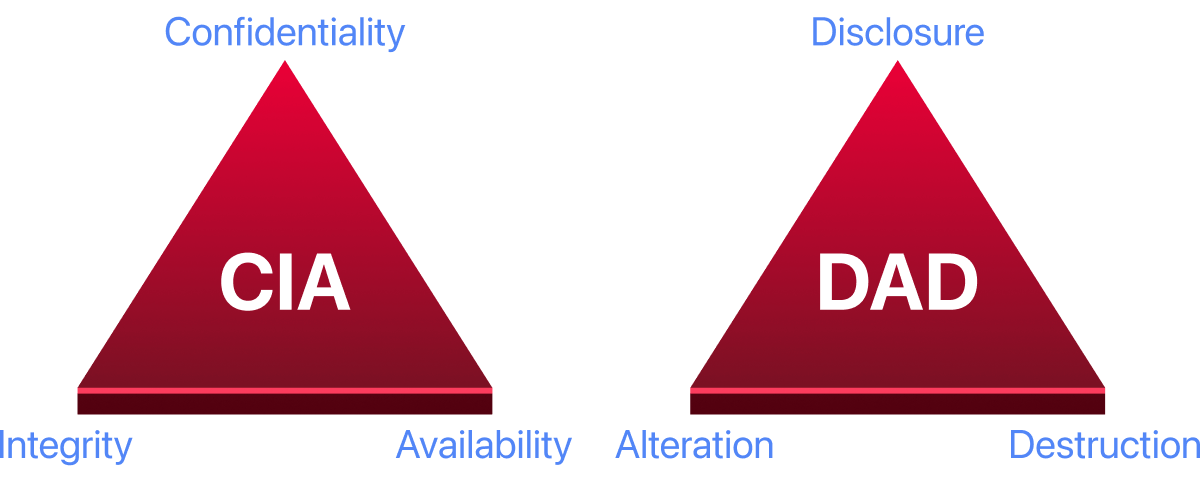
These attacks directly affect the security of the system. Network packet capture violates confidentiality and leads to the disclosure of information. A successful password attack can also lead to disclosure. A Man-in-the-Middle (MITM) attack breaks the system's integrity as it can alter the communicated data. This room focuses on these three attacks because they are integral to protocol design and server implementation.
The Modern Attack Landscape
While the fundamental attack categories remain the same, the landscape has evolved:
- Sniffing attacks are harder on properly configured networks due to widespread adoption, but they remain effective against misconfigured services, internal networks without encryption, and legacy systems.
- MITM attacks are mitigated by technologies like HSTS (HTTP Strict Transport Security), certificate pinning, and Certificate Transparency logs, but they can still succeed when these protections are absent or improperly implemented.
- Password attacks have evolved beyond simple brute force. Attackers now use credential stuffing (trying leaked username/password pairs from breaches), password spraying (trying common passwords across many accounts), and leverage massive breach databases.
Vulnerabilities are of a broader spectrum, and exploited vulnerabilities have different impacts on target systems. For instance, exploiting a Denial of Service () vulnerability can affect the system's availability, while exploiting a Remote Code Execution () vulnerability can lead to more severe damage. A vulnerability by itself creates a risk; damage can occur only when the vulnerability is exploited. Vulnerabilities are not covered in this room as they have their own module, Vulnerability Research.
This room focuses on how a protocol can be upgraded or replaced to protect against disclosure and alteration, protecting the confidentiality and integrity of transmitted data. , a powerful tool for testing password strength by attempting authentication with wordlists, is also introduced. Understanding how attackers approach credential attacks helps you appreciate why strong passwords, account lockout policies, and multi-factor authentication are essential defences.
Note on the lab machine: You will need the attached lab machine starting from Task 5 (SSH). You can start it now or when you reach that task. Tasks 2 through 4 are informational and do not require the .
Ready to learn Cyber Security?
The Protocols and Servers 2 room is only available for Premium or Max subscribers. Signup now to access more than 500 free rooms and learn cyber security through a fun, interactive learning environment.
Already have an account? Log in