Becoming a Cyber Security Analyst
A Cyber Security Analyst (also known as a SOC Analyst) is one of the best early careers in cyber security. You’ll play a pivotal role in a cyber security team with a great starting salary and progression.
Before we get any further, there are several myths we want to dispel right away:
- I need a degree to become a Cyber Security Analyst
Not true! We’ve learned this from so many people who have launched their careers as Cyber Security Analysts without a degree, or even after studying something completely unrelated. By completing relevant learning paths and rooms on TryHackMe, you can develop the skills and knowledge needed to secure (and excel!) in a Cyber Security Analyst role. - I need certifications to show employers I’m ready
You don’t always need certificates. They help, but employers want to see your mastery of the technical side, and there are alternative ways to do this. For example, a portfolio of practical projects. Some examinations do include a practical component which is great, but they can also be expensive! - It’s too difficult to do alone
With TryHackMe, you’ll never do this alone! Learning online doesn’t have to mean learning by yourself. With TryHackMe, you’re supported by a community of over 8+ million users and 210,000 Discord members offering guidance and inspiration every day. From careers advice to help with specific challenges, you’ll get your questions answered fast right here on our platform.
So what are you waiting for? Demand for Cyber Security Analysts continues to grow, with recruiters and employers searching for candidates with your determination and willingness to learn. You can do this!
Read on as we break down each step you’ll need to take to kickstart your career.

What is a Cyber Security Analyst?
A Cyber Security Analyst is a professional responsible for protecting an organisation's computer systems, networks, and data from cyber threats. Their primary role involves monitoring, detecting, investigating, analysing, and responding to security incidents. They use a variety of tools and techniques to ensure the security of an organisation's digital assets, including firewalls, intrusion detection systems, antivirus software, and encryption protocols.
Most Cyber Security Analysts work as part of a Security Operations Center (SOC) team. SOC stands for Security Operations Centre, the central security unit tasked with protecting a company against security threats.
As you progress in the role, you'll generally move through tiers. At Level 1, you’ll be responsible for identifying and investigating threats before escalating them.
You’ll escalate these threats to a Level 2 SOC Analyst who, with a little more experience, can investigate threats further, prioritise, and form a response.
And finally, the Level 3 Analyst has a great amount of responsibility for the overall security picture, and will support the team in threat detection and response. Another key part of this role is upskilling, so you can expect to spend a lot of time researching emerging exploits and their solutions!
With enough experience as a Cyber Security Analyst, you could even progress to SOC Manager and then there's no limit to how far you can go. Someday you’ll reach the holy grail of CISO (if you define holy grail as a “person with ultimate responsibility for the digital health of an organisation”).
Why become a Cyber Security Analyst?
As an entry route into cyber security, the Cyber Security Analyst role brings so many benefits to your hard and soft skills. You will:
- Develop your critical thinking
- Take up numerous opportunities to further your knowledge
- Learn how to operate in a team
- Sharpen your presentation and communication skills
- Handle huge responsibility
Is a Cyber Security Analyst role a suitable fit for me?
Do you have a sharp eye for detail? Ever thought of yourself as a detective? Can you work under pressure? If you answered yes to these questions, the SOC Analyst career path might be just right for you.
Further down, we explore the Cyber Security Analyst requirements you’ll need to perform the role well. Here, we’re talking about mindset. How do you know if you’re the right kind of person to operate in a SOC environment?
- Determined - you’ve got to dig deep to uncover threats. You might perform dozens of the same routine check every day and find no problems. But you have to stay switched on for the moment something doesn’t look right.
- Self-motivated - things move quickly in the security operations centre. Before you’ve had time to celebrate one win, a new threat creeps in.
- Curious - they say you learn something new every day. This is not a cliche phrase for SOC Analysts - in the course of your investigations, you’ll encounter so much information. If you like the idea of expanding your knowledge, this is a good fit.
- Mission-oriented - you’re the guardian of a company’s online security! That’s a bold task, with great responsibility. If you get value from being the (sometimes unsung) hero, this is an opportunity to play a decisive role.
- Calm - you are inheriting the responsibility of protecting a company’s digital assets. There will be times of great pressure. SOC Analysts can set that to one side and focus on the goal.
And if you’re still contemplating the role, check out our ‘day in the life’ of a SOC Analyst!

Learn from a Pro:
Hayden
Hayden used TryHackMe to start a career as a SOC Analyst. Using the platform, he secured himself a job - and he loves it!
"The SOC has always been attractive to me. While combing through logs may sound boring to some, to me, it feels like a treasure hunt. It will be an excellent opportunity for me to learn about various defensive tools while also gaining knowledge about different TTPs. I hope it can someday lead to a position in threat hunting."
Skills for a Cyber Security Analyst
Read enough of job descriptions, and the usual suspects start to crop up. Let’s break down the core capabilities required.
- Monitor infrastructure and digital assets for any malicious activity
- Respond to alerts and investigate incidents depending on the severity of these alerts
- Plan for disaster recovery and create contingency plans in the event of any security breaches
- Work with different departments and stakeholders within an organisation to draft and review security policies and processes
- Work with different departments to ensure that sufficient logging and monitoring is being performed for their critical assets
- Identify potential weaknesses and implement measures, such as firewalls, access gates, encryption, and general security hardening
- Ensure systems in the organisation are hardened according to best practices and that their security patches are kept up to date
- Analyse, measure, and monitor the risk when using external third parties
- Maintain an information security risk register and assist with internal and external audits relating to information security
- Give advice and guidance to staff on issues such as spam and unwanted or malicious emails
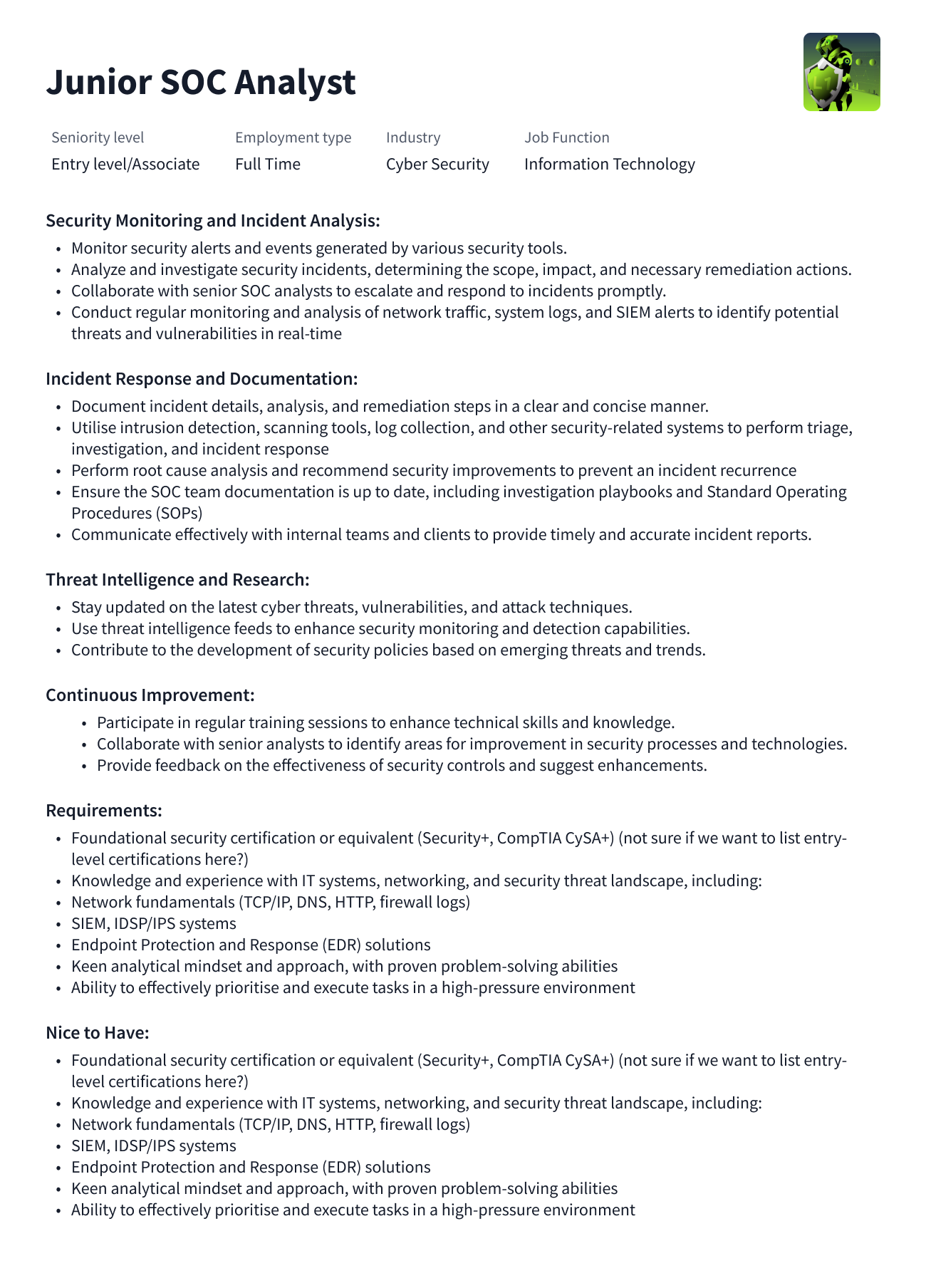
Check out the example job description for a Cyber Security Analyst below!
What do I need to learn to become a Cyber Security Analyst?
At some point we’ve got to ditch the theory and get our hands dirty, right?
TryHackMe gives you the educational foundation to pursue a career as a Cyber Security Analyst. In fact, we have not one, but two learning paths dedicated to this role, with our SOC Level 1 and SOC Level 2 paths. You can also explore a day in the life of an analyst in the Junior Security Analyst Intro room. With TryHackMe, you can keep working towards a promotion even after you get that Level 1 role!
With our platform, you’ll understand how to identify threats in modules like Cyber Threat Intelligence and Network Security & Traffic Analysis before diving deeper into more advanced topics such as Log Analysis, Threat Hunting, and Incident Response.
If you’re starting from zero technical knowledge, we have entire learning paths dedicated to getting you ready: try our Pre-Security or Cyber Security 101 paths first.
0 to 1 with TryHackMe
Don’t just take our word for it! Over to you, Hayden:
In my interview for the SOC Analyst position, I could answer all the technical questions solely based on the knowledge I gained from TryHackMe. The interviewers were impressed that although I had no industry experience, I had been exposed to a variety of tools and frameworks like the Cyber Kill Chain and MITRE. The learning path really helps understand the mindset and objectives of the entire SOC, all while doing it in an entertaining way.
Nice to see interviewers recognising the extensive knowledge to be gained on the TryHackMe platform!
Seeking a Cyber Security Analyst role? Here's everything to know!
Now that you have the skills and know the demands of the role, it's time to see what's out there.
While you can dive right into a job board and start looking for Cyber Security Analyst roles, there are a few things to consider first.FlexibilityA typical Security Operations Centre runs 24/7, so it is really important to consider the working hours offered by the company. Sometimes, companies hire people in different regions with different time zones to cover the scheduling efficiently. However, other companies hire people and offer them to work shifts — it's important to know what's expected of you before you get too invested in the role.RotationsSimilarly, it's important to understand the shifting schedule and how team rotation works. Are you expected to change your weekday availability every month? Every week? You might have a lot of flexibility to accommodate these demands, but sometimes you don't. Knowing this in advance allows you to prioritise roles where the schedule works for you.ResearchWhere possible, do some research on the current state of your potential company's SOC. What's the tech stack (SIEM, EDR, SOAR)? What is the state of SOC visibility? It's frustrating to work on a SOC that doesn't provide enough visibility to complete an investigation because this leads to ineffective detections and analysis.
Get the Job!
You’ve decided a Cyber Security Analyst career is right for you and you’ve completed our SOC Level 1 learning path. What now?
When you’re ready to take the leap, it’s time to begin applying for roles and make yourself seen by recruiters. With all this preparation behind you, you’re in the best possible place to secure an offer and make a start in cyber security. SOC Analysts play a pivotal role in a company’s security strategy, so you’ll get tons of job satisfaction - not to mention a very competitive salary!
You never know what questions may come up in an interview —- the dreaded “Where do you see yourself in ten years” comes to mind. However, with a little preparation, we promise that you can tackle anything your interviewer throws at you! Before you speak to recruiters or employers, be sure to check out our guide for tackling a SOC Analyst job interview.
And if you feel you’re not quite ready, no problem! We have hundreds of training rooms to expand your knowledge. If you’d prefer to get a little experience under your belt first, we have plenty of golden tips for gaining hands-on experience.
After the contract is signed, you can relax and enjoy yourself before your official date!
Advice and tips from our professionals
We asked some of our in-house SOC Analysts to share highlights from their role.
In the eyes of management, a SOC is there to minimise risk. Therefore, the most successful cyber security analyst is going to be one who understands what poses a risk to the organisation, and responds to minimise that risk as quickly as possible. The more a SOC aligns with this goal, the better the life for the analysts and for management. To reach this goal, fine-tuned logs and good visibility are very important.
Umair
Share

SOC Level 1 Learning Path
This path will introduce a wide array of tools and real-life analysis scenarios, enabling you to get your first job as a Junior Security Analyst.