Becoming an Incident Responder
Incident Responders are the detectives of the cyber realm. They meticulously comb through mountains of data, analysing logs and network traffic to uncover the source and scope of security breaches.
Think of an Incident Responder as the first responder of the cyber security world! Just like firefighters containing a fire to prevent it from spreading, Incident Responders swiftly contain cyber incidents to minimise damage by containing the threat, isolating affected systems, disabling compromised accounts, and implementing temporary fixes to stem the tide of the breach.
While the job may not involve heroic capes, Incident Responders' work is vital in safeguarding organisations against the digital world's ever-evolving threats.
- I need a degree for an Incident Responder role
Actually, this is not true! We’ve spoken to hundreds of TryHackMe users who have launched their Incident Response careers long after university, often studying something completely unrelated (or not attending university at all!). If this was ever a requirement, it’s now definitely a thing of the past—although it can, of course, help! - I need Incident Response certificates under my belt
You don’t! While employers do want to see your mastery of the technical side, there are other ways to do this. For example, a portfolio of practical projects. Some examinations do include a practical component which is great, but they can also be expensive! - It’s too difficult to do alone
With TryHackMe, you’ll never be alone! We have millions of users just like you and over 210,000 members in our Discord community who offer support, guidance, and inspiration
So what are you waiting for?
Read on as we break down each step you’ll need to take to kickstart your Incident Responder career.

What is an Incident Responder?
To go into more detail, an Incident Responder is a professional responsible for detecting, investigating, and responding to security incidents within an organisation's IT infrastructure. These incidents can include cyber attacks, data breaches, malware infections, insider threats, and other security breaches.
The role of an incident responder is crucial for minimising the impact of security incidents and protecting the organisation's assets, including sensitive data, systems, and networks. Incident responders typically work as part of a dedicated cyber security team or within an organisation's IT or security operations center (SOC).
The career path for an Incident Responder in cyber security offers a range of opportunities for growth, advancement, and specialisation. Continuous learning and staying updated on emerging threats and technologies are key factors for career progression in this field!
Why become an Incident Responder?
Why consider becoming an Incident Responder? There are a lot of advantages to the role both for progression within this discipline and for transitioning into other areas of cyber security.
- Variety and Challenge:
Every security incident is unique, presenting different challenges and requiring creative problem-solving skills. As an Incident Responder, you'll constantly encounter new threats, tactics, and techniques, which keeps the work interesting and intellectually stimulating - Learning & Skill Development:
Cyber security is a rapidly evolving field, with new threats and technologies constantly emerging. Incident Responders have the opportunity to continuously learn and develop their skills to stay ahead of cyber threats. From mastering new tools and techniques to understanding the latest attack vectors, there's always something new to explore and keep you on your toes! - High Demand and Job Security: With cyber attacks increasing in frequency and sophistication, there is a growing demand for skilled Incident Responders across industries. Organisations are investing more in cyber security, which translates to strong job prospects and job security for qualified professionals in this field.
- Impact and Contribution: As an Incident Responder, you have a direct impact on the security and resilience of organisations. By quickly detecting and responding to security incidents, you help minimise the impact of cyber threats and protect critical assets, including sensitive data, intellectual property, and infrastructure.
- Career Advancement Opportunities: Incident Responders often have opportunities for career advancement and progression within cyber security. With experience and expertise, you can advance to leadership roles, specialise in specific areas of incident response or cyber security, or transition into related fields such as consulting, threat intelligence, or security management.
Is an Incident Responder role a suitable fit for me?
An incident response career path might be for you!
And what about the soft skills? How do you know if you’re the right kind of person to operate as an Incident Responder?
- Analytical Thinking -Incident Responders must be able to analyse complex situations, identify patterns, and understand the underlying causes of security incidents. Strong analytical skills are essential!
- Problem-Solving Skills - Cyber security incidents often present challenging and unpredictable problems that require quick thinking and creative solutions. Incident Responders must be adept at troubleshooting issues, thinking on their feet, and devising effective strategies to contain and mitigate security threats.
- Attention to Detail - The ability to pay close attention to detail is critical for Incident Responders, as even small oversights can have significant consequences in cyber security. They must carefully examine logs, network traffic, and other forensic evidence to uncover the root cause of incidents and ensure thorough documentation of response efforts.
- Effective Communication - Incident Responders need strong communication skills to effectively coordinate response efforts, collaborate with internal teams and external stakeholders, and convey technical information to non-technical audiences.
Learn from a Pro:
Tinus Green
“It had been a while since I was assigned to be a consultant for a forensic investigation assignment. Feeling rusty with my blue teaming skills, I played with some of TryHackMe's Incident Response module rooms and the IR Timeline Analysis room as a quick refresher. The materials helped me to get back on track and learn new tricks. I believe that the blue teaming content of TryHackMe serves as good learning material not only for security analysts who want to specialise in incident response but also for experienced analysts who want to polish and hone their skills”
Skills to become an Incident Responder
As an Incident Responder, you will need a blend of technical proficiency in cyber security, networking, and operating systems to effectively identify and mitigate threats. Analytical and problem-solving skills are essential for assessing risks and developing solutions quickly under pressure.
To go into more detail, these skills are greatly appreciated in the role:
Technical Proficiency:An understanding of operating systems, cyber security tools (such as SIEM, IDS/IPS, and endpoint security solutions), and familiarity with cloud computing platforms and services.Cyber Security FundamentalsUnderstanding of common cyber threats, attack vectors, and malware types, with a knowledge of security controls, best practices, and compliance standards.Forensic AnalysisProficiency in digital forensic techniques, with the ability to conduct disk imaging, memory analysis, and file system analysis.Critical ThinkingAnalytical mindset to assess and prioritise security incidents based on their potential impact.Problem-SolvingThe ability to solve skills to quickly identify root causes of incidents and develop effective response strategies is essential!Teamwork and CollaborationCollaboration skills to work effectively with cross-functional teams, including IT, security, legal, and management stakeholders.Adaptability and ResilienceAbility to thrive in fast-paced and high-pressure environments, adapting quickly to evolving threats and changing priorities.Continuous LearningCommitment to staying updated on the latest cyber security trends, threat intelligence, and industry developments.Ethical and Legal AwarenessUnderstanding of ethical considerations and legal requirements related to incident response, data privacy, and handling of digital evidence.
Required Skills:
- Monitoring systems and networks for signs of security incidents, such as unauthorised access attempts, malware infections, or unusual behaviour
- Quickly assess the severity and impact of security incidents to determine the appropriate response actions and prioritise them accordingly
- Taking immediate steps to contain security incidents to prevent further damage or unauthorised access, and implementing mitigation measures to minimise impact
- Conducting thorough forensic analysis to gather evidence, understand the root cause of incidents, and identify the tactics, techniques, and procedures (TTPs) used by attackers
- Effectively communicating with internal teams, external stakeholders, and relevant authorities throughout the incident response process to ensure timely information sharing and collaboration.
- Developing and implementing remediation plans to address vulnerabilities and weaknesses that contributed to incidents, and restoring affected systems and data to a secure state
- Generating comprehensive incident reports for management, regulatory bodies, or other stakeholders
- Evaluating and improving incident response processes, procedures, and tools based on lessons learned from previous incidents, industry best practices, and emerging threats to enhance the organisation's overall security posture
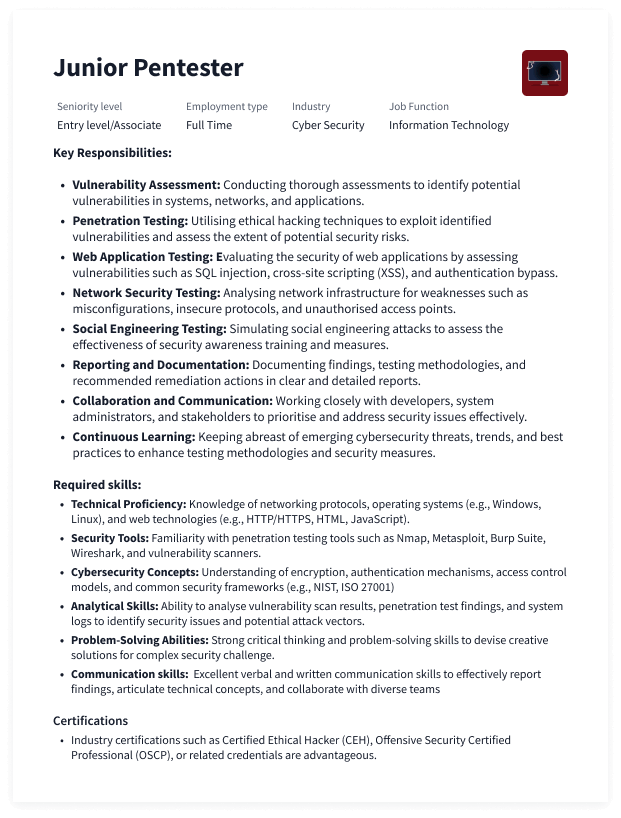
Check out the example job description for a Penetration Tester below!
What do I need to learn to become an Incident Responder?
TryHackMe gives you the educational foundation to pursue a career as an Incident Responder, with training dedicated to incident response, SOC operations, and cyber defence.
We have not one, but two learning paths dedicated to cyber defence and incident operations, with our SOC Level 1 and SOC Level 2 paths. We also recommend checking out our incident response module, where we'll walk you through the mindset behind effective response to security incidents, and apply them through real-world tactics and techniques.
If you're starting from zero technical knowledge, we have entire learning paths dedicated to getting you ready: try our Pre-Security or Cyber Security 101 paths first.
0 to 1 with TryHackMe
Don’t just take our word for it! Over to you, Ariz:
It had been a while since I was assigned to be a consultant for a forensic investigation assignment. Feeling rusty with my blue teaming skills, I played with some of TryHackMe"s Incident Response module rooms and the IR Timeline Analysis room as a quick refresher. The materials helped me to get back on track and learn new tricks. I believe that the blue teaming content of TryHackMe serves as good learning material not only for security analysts who want to specialise in incident response but also for experienced analysts who want to polish and hone their skills
Even the pros find reasons to come back to TryHackMe!
Seeking an Incident Response role? Here’s everything to know!
Now you’ve got the skills and you know the demands of the role, it’s time to see what’s out there.
While you can dive right into a job board and start looking for roles in incident response, there are some things you’ll want to consider first!Problem-Solving AbilitiesEvaluate your problem-solving skills and ability to think critically under pressure! Incident Responders often encounter complex and rapidly evolving security threats, requiring quick thinking and innovative solutions to mitigate risks and minimise impact.Communication SkillsConsider your communication abilities, both verbal and written. Incident Responders must effectively communicate with various stakeholders, including technical teams, management, legal counsel, and external partners. Clear and concise communication is crucial for coordinating response efforts and conveying technical information to non-technical audiences.Working EnvironmentsReflect on your ability to manage stress and handle high-pressure situations. Incident response can be demanding, with tight deadlines, evolving threats, and the need to make critical decisions under pressure. Developing resilience and effective stress management strategies is important for success in this role!
Get the Job!
You've decided an incident response career path is right for you and you've completed our SOC Level 1 path and incident response training. What now?
With all this practical preparation behind you, you're in the best possible place to secure an offer and start your incident response career.
With a little preparation, you can tackle anything your interviewer throws at you. To help you exceed, we recommend a read of our cyber security interview guide.
And if you feel you're not quite ready, don't stress! We have hundreds of training rooms to expand your knowledge in incident response. If you'd prefer to get a little experience under your belt first, we have plenty of expert tips for gaining hands-on experience.
Share

Incident Responder
Learn the practical skills required to start your career as a professional Incident Responder.