Becoming a Penetration Tester
Penetration testers prod around a company’s security defences looking for weaknesses, vulnerabilities, or opportunities for exploitation.
They are the besieging army to a Kingdom’s castle, looking for ways to break down the gates and storm the keep.
Finding flaws is vital to a company’s information security, so this is an in-demand role that is highly specialised with great earning potential.
Before we get any further, there are several myths we want to dispel right away:
- I need a degree to become a Penetration Tester
Not true! We’ve learned from so many people who have launched their pentesting career long after university, often studying something completely unrelated (or not attending university at all!) If this was ever a requirement, it’s definitely a thing of the past with the huge amount of content available to you online. - I need eight different certificates to show employers I’m ready
Again, this is not true! Employers want to see your mastery of the technical side, yes, but there are other ways to do this. For example, a portfolio of practical projects. Some examinations do include a practical component which is great, but they can also be expensive! - It’s too difficult to do alone
With TryHackMe, you’ll never do this alone. We have over 210,000 Discord members offering support, guidance, and inspiration every day. From careers advice to help with specific challenges, you’ll get your questions answered fast right here on our platform.
So what are you waiting for?
Read on as we break down each of the steps to becoming a Penetration Tester and kickstarting your career!

What is a Penetration Tester?
A Penetration Tester helps companies identify weaknesses in their security. If you’ve heard the term “ethical hacker” or “white hat hacker”, this applies to pentesters. They break into systems only to help companies create more robust defences through consultations and reporting. Pentesters submit detailed breakdowns of any vulnerabilities they have discovered, which is essential for companies to understand security weaknesses and actions to address them.
These attacks aren’t simulations - you’re actually trying to break a company’s security! Or at the very least, you’ll perform malicious actions with the access or data you gain. However, you’ll be doing it in a controlled testing environment.
The goal is to help educate a company on how they can make essential security improvements by wearing an attacker’s shoes to find security gaps. Penetration Testers are a huge asset to organisations seeking to test the strength of their information security.
Some larger companies hire pentesters in-house, while others make use of agencies or freelancers.
Becoming a Pentester means building a foundation of cyber security knowledge first. You’ll need to be familiar with information systems and network architecture as well as common exploits and testing methodologies. As a result, this is a very competitive entry-level career. Junior Penetration Testers will often have IT Analyst or System Administration roles before specialising.
Once you’re in, the scope for growth and specialisation is enormous. You might excel at web application security, malware development, or even managing offensive (“red”) security teams.
Depending on the company, Junior Pentesters might work on the same projects as more experienced professionals. Sometimes they work on less critical parts of a company’s security and may contribute to reports rather than own them outright. Penetration Testers handle end-to-end testing and reporting, while offensive team managers coordinate the entire strategy for testing a company’s cyber defences.
Why become a Penetration Tester?
As an entry route into cyber security, the penetration tester role brings so many benefits to your hard and soft skills. You will:
- Develop an adversarial mindset that will benefit both offensive and defensive sides of security operations
- Continuously evolve your security testing methodology and stay aware of emerging threats and techniques
- Conduct rigorous assessments of companies’ security posture, and provide actionable recommendations for remediation and risk mitigation
- Collaborate with stakeholders, including IT teams, security professionals, and executive leadership to document and present identified findings and vulnerabilities
And given the amount of responsibility, this role has one of the highest salaries at the early career stage!
Is a Penetration Tester role a suitable fit for me?
Are you drawn to the “hackier” side of cyber security? Do you enjoy learning the ins and outs of systems so you can gain an advantage? Are you detail-oriented and determined to find holes to poke?
If you answered yes to these questions, the pentester career path might be just right for you.
And what about the soft skills? How do you know if you’re the right kind of person to operate as a pentester?
If you answered yes to these questions, the pentester career path might be just right for you.
And what about the soft skills? How do you know if you’re the right kind of person to operate as a pentester?
- Resourceful - another day, another software update - which often means another exploit opportunity. Pentesters have to be lifelong learners: you’ll know what the emerging threats are for the technology you’re testing, and you’ll incorporate new methods into your work as you grow.
- Communicative - vulnerabilities are high risk for organisations. Senior stakeholders from non-technical backgrounds want to hear what you have to say. You’ll need to boil down your findings into non-technical language so those leaders and decision-makers can understand the stakes.
- Thorough - uncovering a vulnerability will take lots of work. You’re the kind of person who takes a fine-toothed comb to a project to ensure every possibility has been tested.
- Hungry - you seek out new opportunities to upskill and broaden your knowledge.
- Patient - finding a critical vulnerability might take time - it might be buried deep. It’s important not to rush in order to reach the right conclusions.
- Confident writer - when you’re satisfied with the practical, you’ll need to set your findings and recommendations down in a report. You’ll need strong writing skills in order to structure your results and communicate them in a no-nonsense, detailed way.
Skills for a Penetration Tester
Read enough of job descriptions, and the usual suspects start to crop up. Let’s break down the core capabilities required.
As an entry-level Penetration Tester, your role involves evaluating the security posture of computer systems, networks, and applications through simulated cyberattacks. You will collaborate with cyber security teams to perform comprehensive penetration testing activities, including:
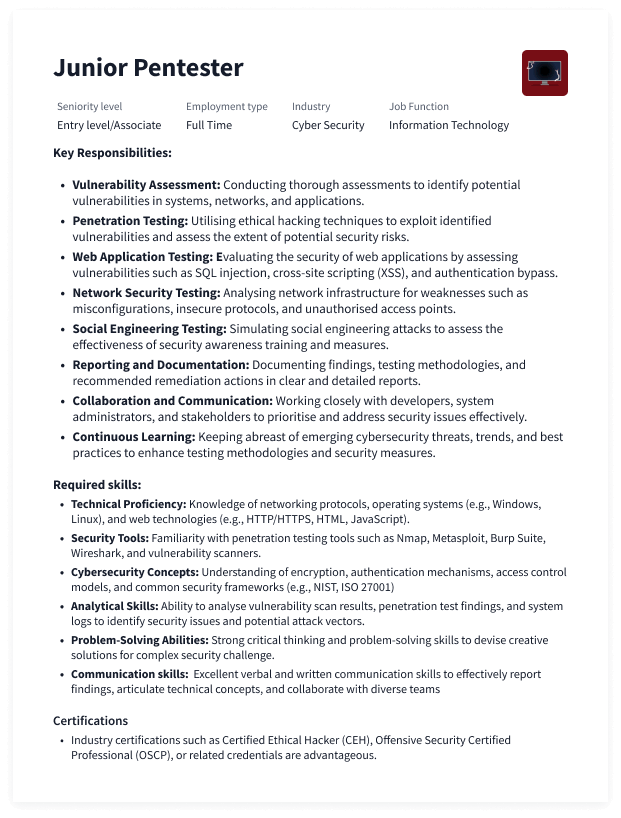
Vulnerability AssessmentConducting thorough assessments to identify potential vulnerabilities in systems, networks, and applications.Penetration TestingUtilising ethical hacking techniques to exploit identified vulnerabilities and assess the extent of potential security risks.Web Application TestingEvaluating the security of web applications by assessing vulnerabilities such as SQL injection, cross-site scripting (XSS), and authentication bypass. You can practise these techniques in OWASP Juice Shop.Network Security TestingAnalysing network infrastructure for weaknesses such as misconfigurations, insecure protocols, and unauthorised access points.Social Engineering TestingSimulating social engineering attacks to assess the effectiveness of security awareness training and measures.Reporting and DocumentationDocumenting findings, testing methodologies, and recommended remediation actions in clear and detailed reports.Collaboration and CommunicationWorking closely with developers, system administrators, and stakeholders to prioritise and address security issues effectively.Continuous LearningKeeping abreast of emerging cyber security threats, trends, and best practices to enhance testing methodologies and security measures.
Required Skills:
Technical ProficiencyKnowledge of networking protocols, operating systems (e.g., Windows, Linux), and web technologies (e.g., HTTP/HTTPS, HTML, JavaScript)Security ToolsFamiliarity with penetration testing tools such as Nmap, Metasploit, Burp Suite, Wireshark, and vulnerability scannersCyber Security ConceptsUnderstanding of encryption, authentication mechanisms, access control models, and common security frameworks (e.g., NIST, ISO 27001)Analytical SkillsAbility to analyse vulnerability scan results, penetration test findings, and system logs to identify security issues and potential attack vectorsProblem-Solving AbilitiesStrong critical thinking and problem-solving skills to devise creative solutions for complex security challengesCommunication SkillsExcellent verbal and written communication skills to effectively report findings, articulate technical concepts, and collaborate with diverse teamsCertificationsIndustry certifications such as Certified Ethical Hacker (CEH), Offensive Security Certified Professional (OSCP), or related credentials are advantageous. If you are preparing for a pentesting certification track, follow the PenTest+ path.
Check out the example job description for a Penetration Tester below!
What Do I Need to Learn to Become a Penetration Tester?
Want to learn how to become a Pentester? Well, at some point we’ve got to ditch the theory and get our hands dirty, right?
TryHackMe gives you the educational foundation to pursue a career as a Penetration Tester. In fact, we have several learning paths dedicated to this role - Red Teaming, Jr Penetration Tester, and Offensive Pentesting. That’s dozens of hours of content designed to get you your first job AND help you progress your career.
With our platform, you’re on the right path to become a Penetration Tester. You'll learn a strong pentesting methodology in modules like Network Security, Web Hacking, Initial Access, and Privilege Escalation before diving deeper into more advanced topics such as network and host evasion and compromising Active Directory environments.
If you’re starting with zero technical knowledge, we have entire learning paths dedicated to getting you ready: try our Pre-Security or SOC Level 1 paths first. You can also build your foundations with Pentesting Fundamentals.
Seeking a Penetration Tester role? Here's everything to know!
Now that you have the skills and know the demands of the role, it's time to see what's out there.
While you can dive right into a job board and start looking for Pentester roles, there are a few things to consider first.Time managementAre you good with deadlines? Can you organise your day-to-day tasks well? It's really important to set and meet goals as a Pentester because the work is urgent and moves fast. From a company perspective, if there's a security risk lurking somewhere then they'll want it discovered with actionable fixes as fast as possible. This is good from a job satisfaction perspective because you know you're essential, but you have to make sure you can keep up with things.CommunicationSo much of the job is report writing. While the white hat hacking part of the role gets a lot of publicity, communicating your findings is equally important. The risks and recommendations you raise will be read by technical and non-technical folks. Therefore, your written style needs to be accessible but still informative.Work/Life BalanceThe good news! Penetration testing isn't a 24/7 role like a SOC Analyst. As far as cyber security careers go, it's a good one for regulated working hours with little need for shift work or nights/weekends. While the hours will vary based on company, it's generally easier to find that balance.VarietyCompanies have assets across so many domains: web, API, mobile, and network, for example. Each of these comes with its own suite of vulnerabilities and tests. You'll be able to find a good deal of variation in your role, especially if you can rotate.
Get the Job!
You’ve decided a Pentester career is right for you and you’ve completed our Jr Penetration Tester learning path. What now?
If you feel like you’re ready, it’s time to take the leap and begin applying for roles! You’re never going to know for sure what questions may come up in an interview - the dreaded “where do you see yourself in ten years” always comes to mind. But with all this preparation behind you, you’re in the best possible place to secure an offer and make a start in cyber security.
Before you speak to recruiters or employers, be sure to check out our guide for tackling a Junior Pentester job interview.
And if you feel you’re still not quite there, no problem! We have hundreds of training rooms to expand your knowledge. If you’d prefer to get a little experience under your belt first, we have plenty of tips for gaining hands-on experience gathered by industry professionals who were once in your shoes!
Get Started: Tips from Penetration Testers
Let’s hear from some penetration testers! Here are some people with real-life experience in the role giving their top tips for the first few months on the job.
Likely first tasks
Likely first tasks
- Understanding the environment (if an internal pentester)
- Set up your testing environment
- Reading documentation
- Being mentored by other testers, learning processes from them
- Sitting in with client calls
- Shadowing engagements
- Get familiar with any proprietary internal company tools and scripts
- Review your company’s documentation and processes
- Take detailed notes early on
- Stay organised, and categorise notes for tasks, projects, etc.
Share

Jr Penetration Tester
Learn the practical skills required to start your career as a professional Penetration Tester.