We use cookies to ensure you get the best user experience. For more information see our cookie policy.
Vulnerabilities 101
Understand the flaws of an application and apply your researching skills on some vulnerability databases.
Task 1: Introduction
Cybersecurity is big business in the modern-day world. The
hacks that we hear about in newspapers are from exploiting vulnerabilities. In
this room, we're going to explain exactly what a vulnerability is, the types of
vulnerabilities and how we can exploit these for success in our penetration
testing endeavours.
An enormous part of penetration testing is knowing the
skills and resources for whatever situation you face. This room is going to
introduce you to some resources that are essential when researching
vulnerabilities, specifically, you are going to be introduced to:
What vulnerabilities are
Why they're worthy of learning about
How are vulnerabilities rated
Databases for vulnerability research
A showcase of how vulnerability research is used on ACKme's engagement
Answer the questions below
Read this task!
Task 2: Introduction to Vulnerabilities
A vulnerability in cybersecurity is defined as a weakness or
flaw in the design, implementation or behaviours of a system or application. An
attacker can exploit these weaknesses to gain access to unauthorised
information or perform unauthorised actions. The term “vulnerability” has many
definitions by cybersecurity bodies. However, there is minimal variation
between them all.
For example, NIST defines a vulnerability as “weakness in an information system, system security
procedures, internal controls, or implementation that could be exploited or
triggered by a threat source”.
Vulnerabilities can originate from many factors, including a
poor design of an application or an oversight of the intended actions from a
user.
We will come on to discuss the various types of
vulnerabilities in a later room. However, for now, we should know that there
are arguably five main categories of vulnerabilities:
Vulnerability
Description
Operating System
These types of vulnerabilities are found within Operating Systems (OSs) and often result in privilege escalation.
(Mis)Configuration-based
These types of vulnerability stem from an incorrectly configured application or service. For example, a website exposing customer details.
Weak or Default Credentials
Applications and services that have an element of authentication will come with default credentials when installed. For example, an administrator dashboard may have the username and password of "admin". These are easy to guess by an attacker.
Application Logic
These vulnerabilities are a result of poorly designed applications. For example, poorly implemented authentication mechanisms that may result in an attacker being able to impersonate a user.
Human-Factor
Human-Factor vulnerabilities are vulnerabilities that leverage human behaviour. For example, phishing emails are designed to trick humans into believing they are legitimate.
As a cybersecurity researcher, you will be assessing applications
and systems - using vulnerabilities against these targets in day-to-day life,
so it is crucial to become familiar with this discovery and exploitation
process.
Answer the questions below
An attacker has been able to upgrade the permissions of their system account from "user" to "administrator". What type of vulnerability is this?
You manage to bypass a login panel using cookies to authenticate. What type of vulnerability is this?
Task 3: Scoring Vulnerabilities (CVSS & VPR)
Vulnerability management is the process of evaluating, categorising
and ultimately remediating threats (vulnerabilities) faced by an organisation.
It is arguably impossible to patch and remedy every single
vulnerability in a network or computer system and sometimes a waste of resources.
After all, only approximately 2% of vulnerabilities only ever end up being
exploited (Kenna security., 2020). Instead, it is all about addressing the most dangerous vulnerabilities and
reducing the likelihood of an attack vector being used to exploit a system.
This is where vulnerability scoring comes into play. Vulnerability
scoring serves a vital role in vulnerability management and is used to determine
the potential risk and impact a vulnerability may have on a network or computer
system. For example, the popular Common Vulnerability Scoring System (CVSS)
awards points to a vulnerability based upon its features, availability, and reproducibility.
Of course, as always in the world of IT, there is never just
one framework or proposed idea. Let’s explore two of the more common frameworks
and analyse how they differ.
Common Vulnerability Scoring System
First introduced in 2005, the Common Vulnerability Scoring System (or CVSS) is a very popular framework for vulnerability scoring and has three major iterations. As it stands, the current version is CVSSv3.1 (with version 4.0 currently in draft) a score is essentially determined by some of the following factors (but many more):
1. How easy is it to exploit the vulnerability?
2. Do exploits exist for this?
3. How does this vulnerability interfere with the CIA triad?
In fact, there are so many variables that you have to use a calculator to figure out the score using this framework. A vulnerability is given a classification (out of five) depending on the score that is has been assigned. I have put the Qualitative Severity Rating Scale and their score ranges into the table below.
Rating
Score
None
0
Low
0.1 - 3.9
Medium
4.0 - 6.9
High
7.0 - 8.9
Critical
9.0 - 10.0
However, CVSS is not a magic bullet. Let's analyse some of the advantages and disadvantages of CVSS in the table below:
Advantages of CVSS
Disadvantages of CVSS
CVSS has been around for a long time.
CVSS was never designed to help prioritise vulnerabilities, instead, just assign a value of severity.
CVSS is popular in organisations.
CVSS heavily assesses vulnerabilities on an exploit being available. However, only 20% of all vulnerabilities have an exploit available (Tenable., 2020) .
CVSS is a free framework to adopt and recommended by organisations such as NIST.
Vulnerabilities rarely change scoring after assessment despite the fact that new developments such as exploits may be found.
Vulnerability Priority Rating (VPR)
The VPR framework is a much more modern framework in vulnerability management - developed by Tenable, an industry solutions provider for vulnerability management. This framework is considered to be risk-driven; meaning that vulnerabilities are given a score with a heavy focus on the risk a vulnerability poses to the organisation itself, rather than factors such as impact (like with CVSS).
Unlike CVSS, VPR scoring takes into account the relevancy of a vulnerability. For example, no risk is considered regarding a vulnerability if that vulnerability does not apply to the organisation (i.e. they do not use the software that is vulnerable). VPR is also considerably dynamic in its scoring, where the risk that a vulnerability may pose can change almost daily as it ages.
VPR uses a similar scoring range as CVSS, which I have also put into the table below. However, two notable differences are that VPR does not have a "None/Informational" category, and because VPR uses a different scoring method, the same vulnerability will have a different score using VPR than when using CVSS.
Rating
Score
Low
0.0 - 3.9
Medium
4.0 - 6.9
High
7.0 - 8.9
Critical
9.0 - 10.0
Let's recap some of the advantages and disadvantages of using the VPR framework in the table below.
Advantages of VPR
Disadvantages of VPR
VPR is a modern framework that is real-world.
VPR is not open-source like some other vulnerability management frameworks.
VPR considers over 150 factors when calculating risk.
VPR can only be adopted apart of a commercial platform.
VPR is risk-driven and used by organisations to help prioritise patching vulnerabilities.
VPR does not consider the CIA triad to the extent that CVSS does; meaning that risk to the confidentiality, integrity and availability of data does not play a large factor in scoring vulnerabilities when using VPR.
Scorings are not final and are very dynamic, meaning the priority a vulnerability should be given can change as the vulnerability ages.
Intentionally left blank.
Answer the questions below
What year was the first iteration of CVSS published?
If you wanted to assess vulnerability based on the risk it poses to an organisation, what framework would you use?
Note: We are looking for the acronym here.
If you wanted to use a framework that was free and open-source, what framework would that be?
Note: We are looking for the acronym here.
Task 4: Vulnerability Databases
Throughout your journey in cybersecurity, you will often come across a magnitude of different applications and services. For example, a CMS whilst they all have the same purpose, often have very different designs and behaviours (and, in turn, potentially different vulnerabilities).
Thankfully for us, there are resources on the internet that
keep track of vulnerabilities for all sorts of software, operating systems and
more! This room will showcase two databases that we can use to look up existing
vulnerabilities for applications discovered in our infosec journey,
specifically the following websites:
Before we dive into these two resources, let's ensure that our understanding of some fundamental key terms is on the same page:
Term
Definition
Vulnerability
A vulnerability is defined as a weakness or flaw in the design, implementation or behaviours of a system or application.
Exploit
An exploit is something such as an action or behaviour that utilises a vulnerability on a system or application.
Proof of Concept (PoC)
A PoC is a technique or tool that often demonstrates the exploitation of a vulnerability.
NVD – National Vulnerability Database
The National Vulnerability Database is a website that lists
all publically categorised vulnerabilities. In cybersecurity, vulnerabilities are
classified under “Common Vulnerabilities and Exposures” (Or CVE for short).
These CVEs have the formatting of CVE-YEAR-IDNUMBER. For
example, the vulnerability that the famous malware WannaCry used was CVE-2017-0144.
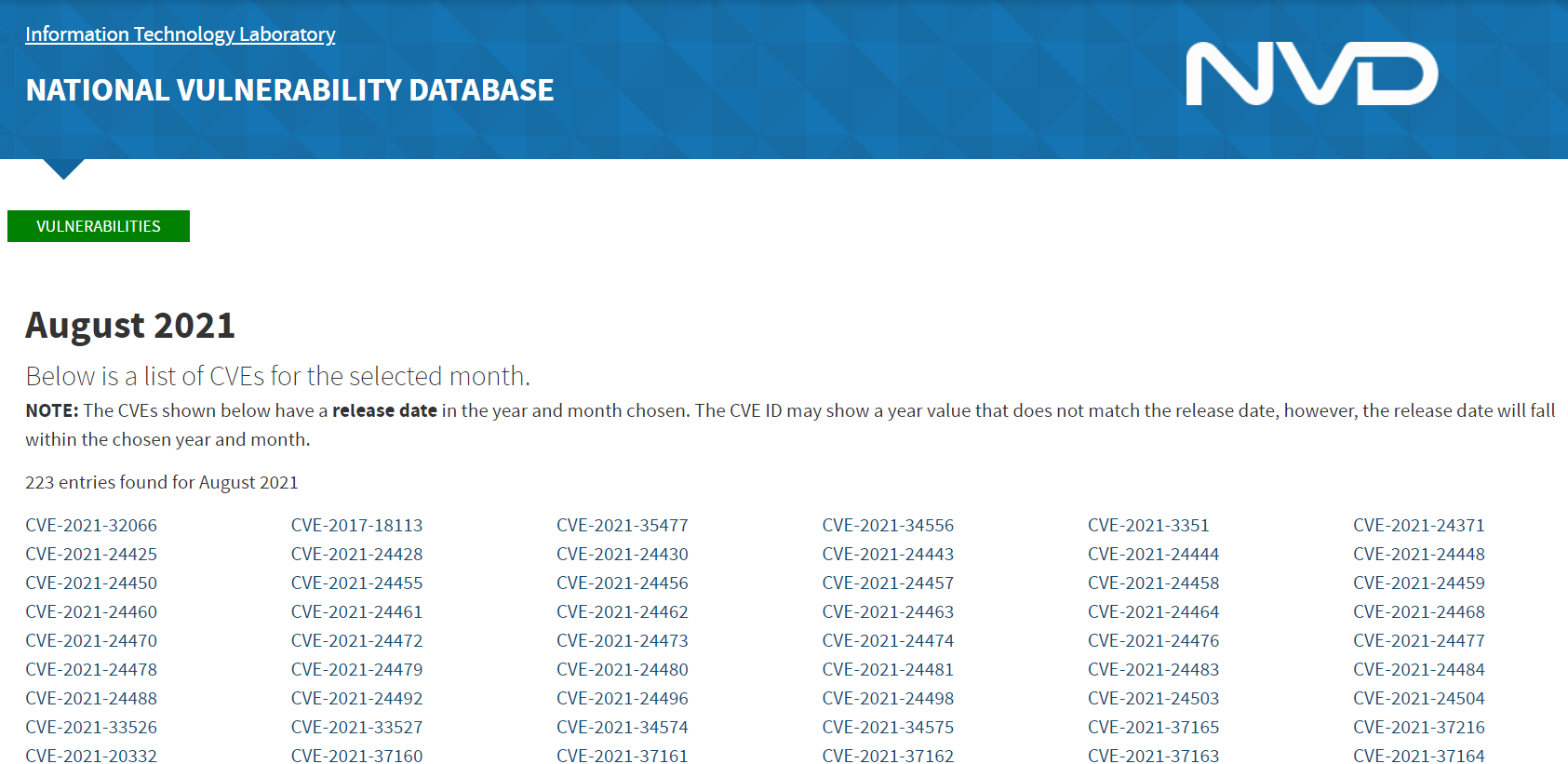
NVD allows you to see all the CVEs that have been confirmed,
using filters by category and month of submission. For example, it is three
days into August; there have already been 223 new CVEs submitted to this
database.
While this website helps keep track of new vulnerabilities,
it is not great when searching for vulnerabilities for a specific application
or scenario.
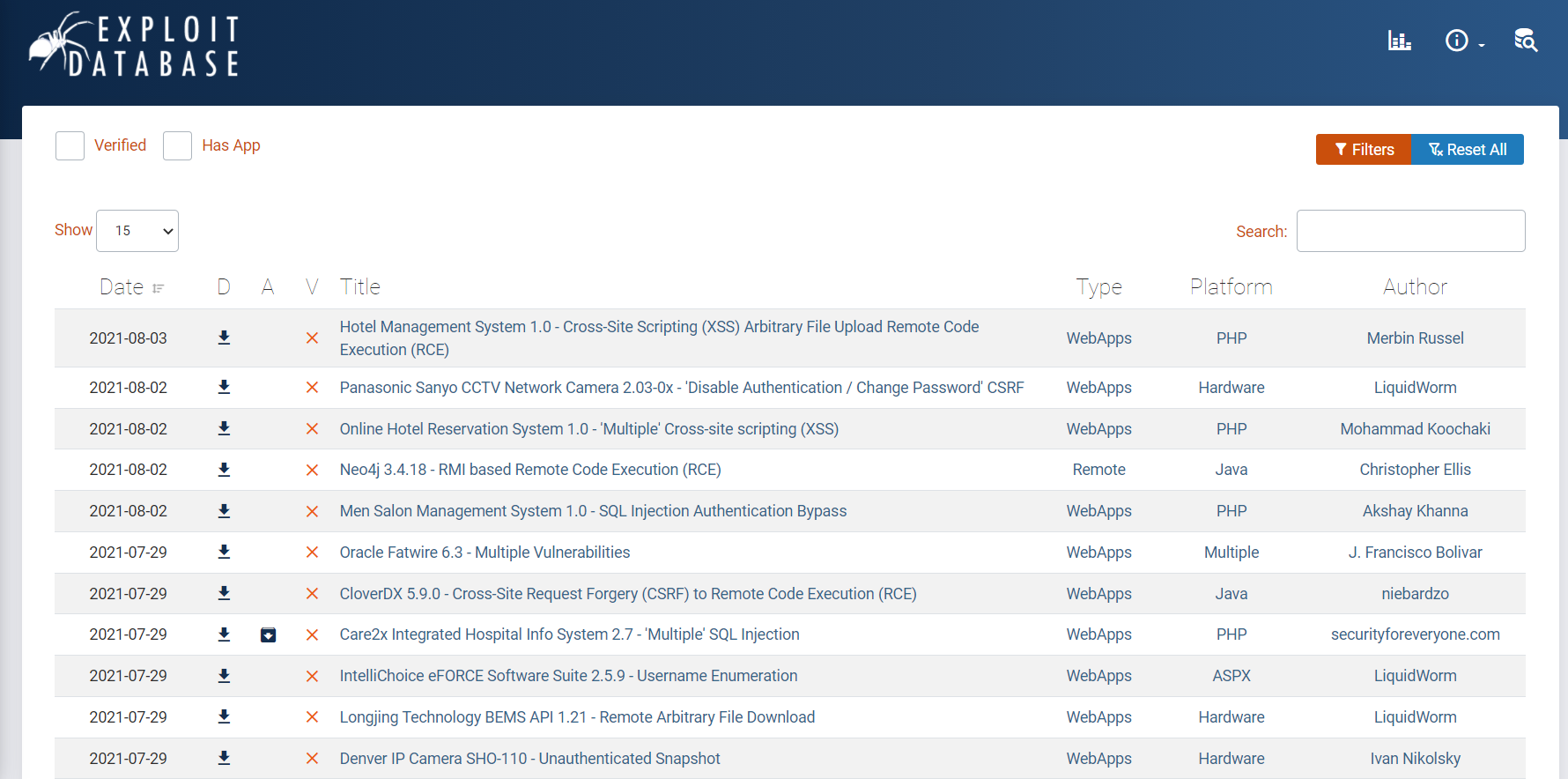
Exploit-DB
Exploit-DB is a resource that we, as hackers, will find much
more helpful during an assessment. Exploit-DB retains exploits for software and
applications stored under the name, author and version of the software or
application.
We can use Exploit-DB to look for snippets of
code (known as Proof of Concepts) that are used to exploit a specific vulnerability.
Answer the questions below
Using NVD, how many CVEs were published in July 2021?
In this task, I’m going to demonstrate the process of finding one minor vulnerability, coupled with some research of the vulnerability databases leading to a much more valuable vulnerability and exploit ultimately.
Throughout an assessment, you will often combine multiple vulnerabilities to get results. For example, in this task, we will leverage the “Version Disclosure” vulnerability to find out the version of an application. With this version, we can then use Exploit-DB to search for any exploits that work with that specific version.
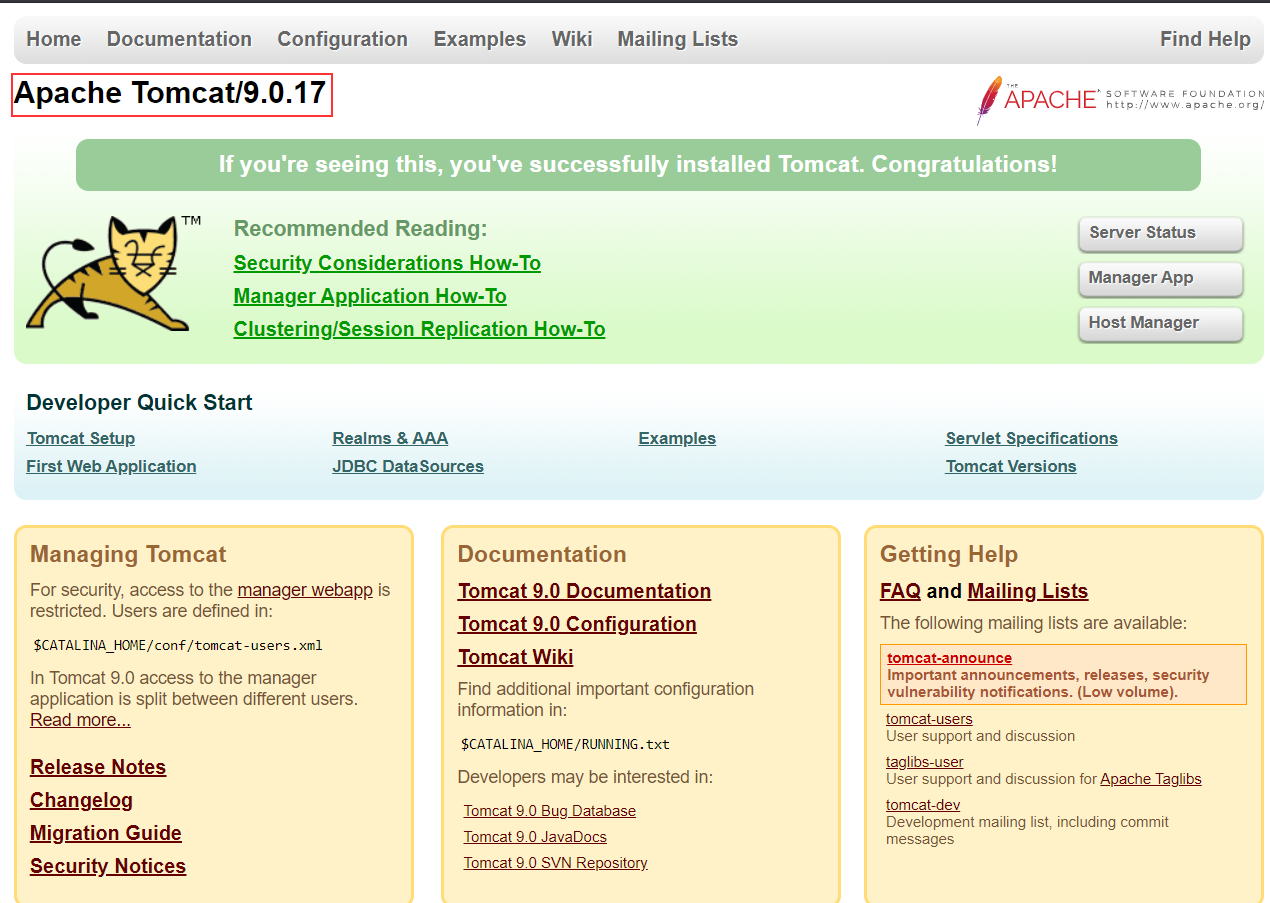
Applications and software usually have a version number. This information is usually left with good intentions; for example, the author can support multiple versions of the software and the likes. Or sometimes, left unintentionally.
For example, in the screenshot below, we can see that the name and version number of this application is “Apache Tomcat 9.0.17”
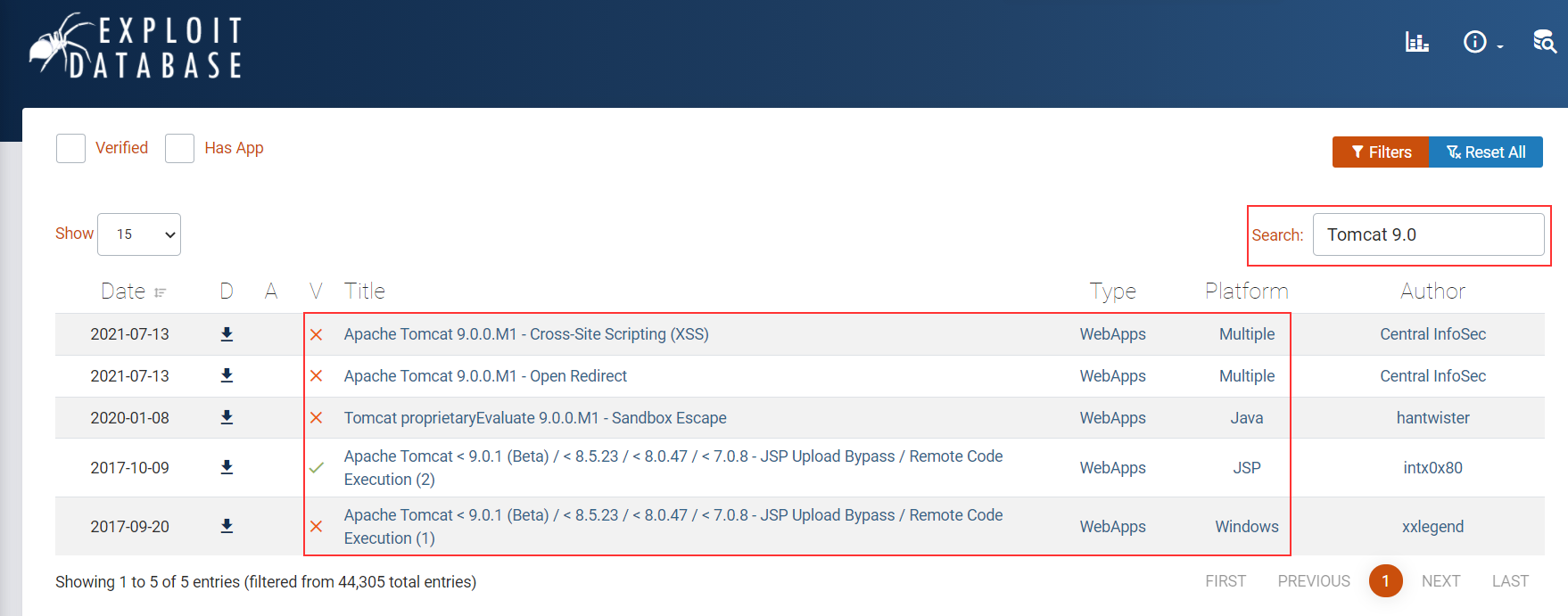
With this information in hand, let’s use the search filter on Exploit-DB to look for any exploits that may apply to “Apache Tomcat 9.0.17”.
Great! After searching Exploit-DB, there are a total of five
exploits that may be useful to us for this specific version of the application.
Answer the questions below
What type of vulnerability did we use to find the name and version of the application in this example?
Task 6: Showcase: Exploiting Ackme's Application
It is your first week on the job as Jr. Penetration tester at ThePentestingCo. For your first engagement, you are shadowing a Sr. Penetration Tester within the company.
Deploy the site attached to this task and follow the steps that the Sr. Penetration Tester took to exploit a vulnerability against ACKme IT Service's infrastructure.
Complete the engagement to retrieve a flag.
Answer the questions below
Follow along with the showcase of exploiting ACKme's application to the end to retrieve a flag. What is this flag?
Task 7: Conclusion
Nice work! We’ve made it to the end. This room has served as
an introductory to vulnerability research and some skills and resources this
requires, where you have practically applied this knowledge.
Answer the questions below
Continue on your learning with the additional rooms in this module.
Understand the flaws of an application and apply your researching skills on some vulnerability databases.
easy
20 min
185,589
To access material, start machines and answer questions login.
Cybersecurity is big business in the modern-day world. The
hacks that we hear about in newspapers are from exploiting vulnerabilities. In
this room, we're going to explain exactly what a vulnerability is, the types of
vulnerabilities and how we can exploit these for success in our penetration
testing endeavours.
An enormous part of penetration testing is knowing the
skills and resources for whatever situation you face. This room is going to
introduce you to some resources that are essential when researching
vulnerabilities, specifically, you are going to be introduced to:
What vulnerabilities are
Why they're worthy of learning about
How are vulnerabilities rated
Databases for vulnerability research
A showcase of how vulnerability research is used on ACKme's engagement
Answer the questions below
Read this task!
A vulnerability in cybersecurity is defined as a weakness or
flaw in the design, implementation or behaviours of a system or application. An
attacker can exploit these weaknesses to gain access to unauthorised
information or perform unauthorised actions. The term “vulnerability” has many
definitions by cybersecurity bodies. However, there is minimal variation
between them all.
For example, defines a vulnerability as “weakness in an information system, system security
procedures, internal controls, or implementation that could be exploited or
triggered by a threat source”.
Vulnerabilities can originate from many factors, including a
poor design of an application or an oversight of the intended actions from a
user.
We will come on to discuss the various types of
vulnerabilities in a later room. However, for now, we should know that there
are arguably five main categories of vulnerabilities:
Vulnerability
Description
Operating System
These types of vulnerabilities are found within Operating Systems (OSs) and often result in privilege escalation.
(Mis)Configuration-based
These types of vulnerability stem from an incorrectly configured application or service. For example, a website exposing customer details.
Weak or Default Credentials
Applications and services that have an element of authentication will come with default credentials when installed. For example, an administrator dashboard may have the username and password of "admin". These are easy to guess by an attacker.
Application Logic
These vulnerabilities are a result of poorly designed applications. For example, poorly implemented authentication mechanisms that may result in an attacker being able to impersonate a user.
Human-Factor
Human-Factor vulnerabilities are vulnerabilities that leverage human behaviour. For example, emails are designed to trick humans into believing they are legitimate.
As a cybersecurity researcher, you will be assessing applications
and systems - using vulnerabilities against these targets in day-to-day life,
so it is crucial to become familiar with this discovery and exploitation
process.
Answer the questions below
An attacker has been able to upgrade the permissions of their system account from "user" to "administrator". What type of vulnerability is this?
You manage to bypass a login panel using cookies to authenticate. What type of vulnerability is this?
Vulnerability management is the process of evaluating, categorising
and ultimately remediating threats (vulnerabilities) faced by an organisation.
It is arguably impossible to patch and remedy every single
vulnerability in a network or computer system and sometimes a waste of resources.
After all, only approximately 2% of vulnerabilities only ever end up being
exploited (Kenna security., 2020). Instead, it is all about addressing the most dangerous vulnerabilities and
reducing the likelihood of an attack vector being used to exploit a system.
This is where vulnerability scoring comes into play. Vulnerability
scoring serves a vital role in vulnerability management and is used to determine
the potential risk and impact a vulnerability may have on a network or computer
system. For example, the popular Common Vulnerability Scoring System ()
awards points to a vulnerability based upon its features, availability, and reproducibility.
Of course, as always in the world of IT, there is never just
one framework or proposed idea. Let’s explore two of the more common frameworks
and analyse how they differ.
Common Vulnerability Scoring System
First introduced in 2005, the Common Vulnerability Scoring System (or CVSS) is a very popular framework for vulnerability scoring and has three major iterations. As it stands, the current version is CVSSv3.1 (with version 4.0 currently in draft) a score is essentially determined by some of the following factors (but many more):
1. How easy is it to exploit the vulnerability?
2. Do exploits exist for this?
3. How does this vulnerability interfere with the triad?
In fact, there are so many variables that you have to use a calculator to figure out the score using this framework. A vulnerability is given a classification (out of five) depending on the score that is has been assigned. I have put the Qualitative Severity Rating Scale and their score ranges into the table below.
Rating
Score
None
0
Low
0.1 - 3.9
Medium
4.0 - 6.9
High
7.0 - 8.9
Critical
9.0 - 10.0
However, CVSS is not a magic bullet. Let's analyse some of the advantages and disadvantages of CVSS in the table below:
Advantages of CVSS
Disadvantages of CVSS
CVSS has been around for a long time.
CVSS was never designed to help prioritise vulnerabilities, instead, just assign a value of severity.
CVSS is popular in organisations.
CVSS heavily assesses vulnerabilities on an exploit being available. However, only 20% of all vulnerabilities have an exploit available (Tenable., 2020) .
CVSS is a free framework to adopt and recommended by organisations such as .
Vulnerabilities rarely change scoring after assessment despite the fact that new developments such as exploits may be found.
Vulnerability Priority Rating ()
The VPR framework is a much more modern framework in vulnerability management - developed by Tenable, an industry solutions provider for vulnerability management. This framework is considered to be risk-driven; meaning that vulnerabilities are given a score with a heavy focus on the risk a vulnerability poses to the organisation itself, rather than factors such as impact (like with CVSS).
Unlike CVSS, VPR scoring takes into account the relevancy of a vulnerability. For example, no risk is considered regarding a vulnerability if that vulnerability does not apply to the organisation (i.e. they do not use the software that is vulnerable). VPR is also considerably dynamic in its scoring, where the risk that a vulnerability may pose can change almost daily as it ages.
VPR uses a similar scoring range as CVSS, which I have also put into the table below. However, two notable differences are that VPR does not have a "None/Informational" category, and because VPR uses a different scoring method, the same vulnerability will have a different score using VPR than when using CVSS.
Rating
Score
Low
0.0 - 3.9
Medium
4.0 - 6.9
High
7.0 - 8.9
Critical
9.0 - 10.0
Let's recap some of the advantages and disadvantages of using the VPR framework in the table below.
Advantages of VPR
Disadvantages of VPR
VPR is a modern framework that is real-world.
VPR is not open-source like some other vulnerability management frameworks.
VPR considers over 150 factors when calculating risk.
VPR can only be adopted apart of a commercial platform.
VPR is risk-driven and used by organisations to help prioritise patching vulnerabilities.
VPR does not consider the CIA triad to the extent that CVSS does; meaning that risk to the confidentiality, and availability of data does not play a large factor in scoring vulnerabilities when using VPR.
Scorings are not final and are very dynamic, meaning the priority a vulnerability should be given can change as the vulnerability ages.
Intentionally left blank.
Answer the questions below
What year was the first iteration of CVSS published?
If you wanted to assess vulnerability based on the risk it poses to an organisation, what framework would you use?
Note: We are looking for the acronym here.
If you wanted to use a framework that was free and open-source, what framework would that be?
Note: We are looking for the acronym here.
Throughout your journey in cybersecurity, you will often come across a magnitude of different applications and services. For example, a whilst they all have the same purpose, often have very different designs and behaviours (and, in turn, potentially different vulnerabilities).
Thankfully for us, there are resources on the internet that
keep track of vulnerabilities for all sorts of software, operating systems and
more! This room will showcase two databases that we can use to look up existing
vulnerabilities for applications discovered in our infosec journey,
specifically the following websites:
Before we dive into these two resources, let's ensure that our understanding of some fundamental key terms is on the same page:
Term
Definition
Vulnerability
A vulnerability is defined as a weakness or flaw in the design, implementation or behaviours of a system or application.
Exploit
An exploit is something such as an action or behaviour that utilises a vulnerability on a system or application.
Proof of Concept ()
A PoC is a technique or tool that often demonstrates the exploitation of a vulnerability.
NVD – National Vulnerability Database
The National Vulnerability Database is a website that lists
all publically categorised vulnerabilities. In cybersecurity, vulnerabilities are
classified under “Common Vulnerabilities and Exposures” (Or for short).
These CVEs have the formatting of CVE-YEAR-IDNUMBER. For
example, the vulnerability that the famous malware WannaCry used was CVE-2017-0144.
NVD allows you to see all the CVEs that have been confirmed,
using filters by category and month of submission. For example, it is three
days into August; there have already been 223 new CVEs submitted to this
database.
While this website helps keep track of new vulnerabilities,
it is not great when searching for vulnerabilities for a specific application
or scenario.
Exploit-DB
Exploit-DB is a resource that we, as hackers, will find much
more helpful during an assessment. Exploit-DB retains exploits for software and
applications stored under the name, author and version of the software or
application.
We can use Exploit-DB to look for snippets of
code (known as Proof of Concepts) that are used to exploit a specific vulnerability.
Answer the questions below
Using NVD, how many CVEs were published in July 2021?
In this task, I’m going to demonstrate the process of finding one minor vulnerability, coupled with some research of the vulnerability databases leading to a much more valuable vulnerability and exploit ultimately.
Throughout an assessment, you will often combine multiple vulnerabilities to get results. For example, in this task, we will leverage the “Version Disclosure” vulnerability to find out the version of an application. With this version, we can then use Exploit-DB to search for any exploits that work with that specific version.
Applications and software usually have a version number. This information is usually left with good intentions; for example, the author can support multiple versions of the software and the likes. Or sometimes, left unintentionally.
For example, in the screenshot below, we can see that the name and version number of this application is “ Tomcat 9.0.17”
With this information in hand, let’s use the search filter on Exploit-DB to look for any exploits that may apply to “Apache Tomcat 9.0.17”.
Great! After searching Exploit-DB, there are a total of five
exploits that may be useful to us for this specific version of the application.
Answer the questions below
What type of vulnerability did we use to find the name and version of the application in this example?
It is your first week on the job as Jr. Penetration tester at ThePentestingCo. For your first engagement, you are shadowing a Sr. Penetration Tester within the company.
Deploy the site attached to this task and follow the steps that the Sr. Penetration Tester took to exploit a vulnerability against ACKme IT Service's infrastructure.
Complete the engagement to retrieve a flag.
Answer the questions below
Follow along with the showcase of exploiting ACKme's application to the end to retrieve a flag. What is this flag?
Nice work! We’ve made it to the end. This room has served as
an introductory to vulnerability research and some skills and resources this
requires, where you have practically applied this knowledge.
Answer the questions below
Continue on your learning with the additional rooms in this module.
Ready to learn Cyber Security?
TryHackMe provides free online cyber security training to secure jobs & upskill through a fun, interactive learning environment.