
Back to all walkthroughs


ASI05: Unexpected Code Execution
Four ways an AI agent ends up running code nobody wrote, reviewed, or approved.
medium
To access material, start machines and answer questions login.
Modern agents don't just call tools; they also write code and run it.
When you ask a coding assistant to fix a failing test, it writes the change and you decide whether to apply it, so a person gets the chance to review the code before it runs. An agent that writes and runs its own code skips that review, and code nobody has read runs straight away. Vibe-coding tools, which build software from plain-language requests, skip it on purpose. Build agents skip it whenever they're trusted to repair their own failures. The Top 10 for Agentic Applications 2026 names this risk ASI05 Unexpected Code Execution, which covers any code an agent runs that no person wrote, reviewed, or approved.
You're the security engineer at TryTrainMe, where eight AI agents run the routine engineering work. You did not build any of them, but you are responsible for their security. Staff talk to the orchestrator, which does none of the work itself and hands each request to whichever specialist owns that area. deploy-agent builds and deploys the platform's services, and it's the only one of the eight that can run a command. Two months ago it was given permission to repair a failing build on its own.
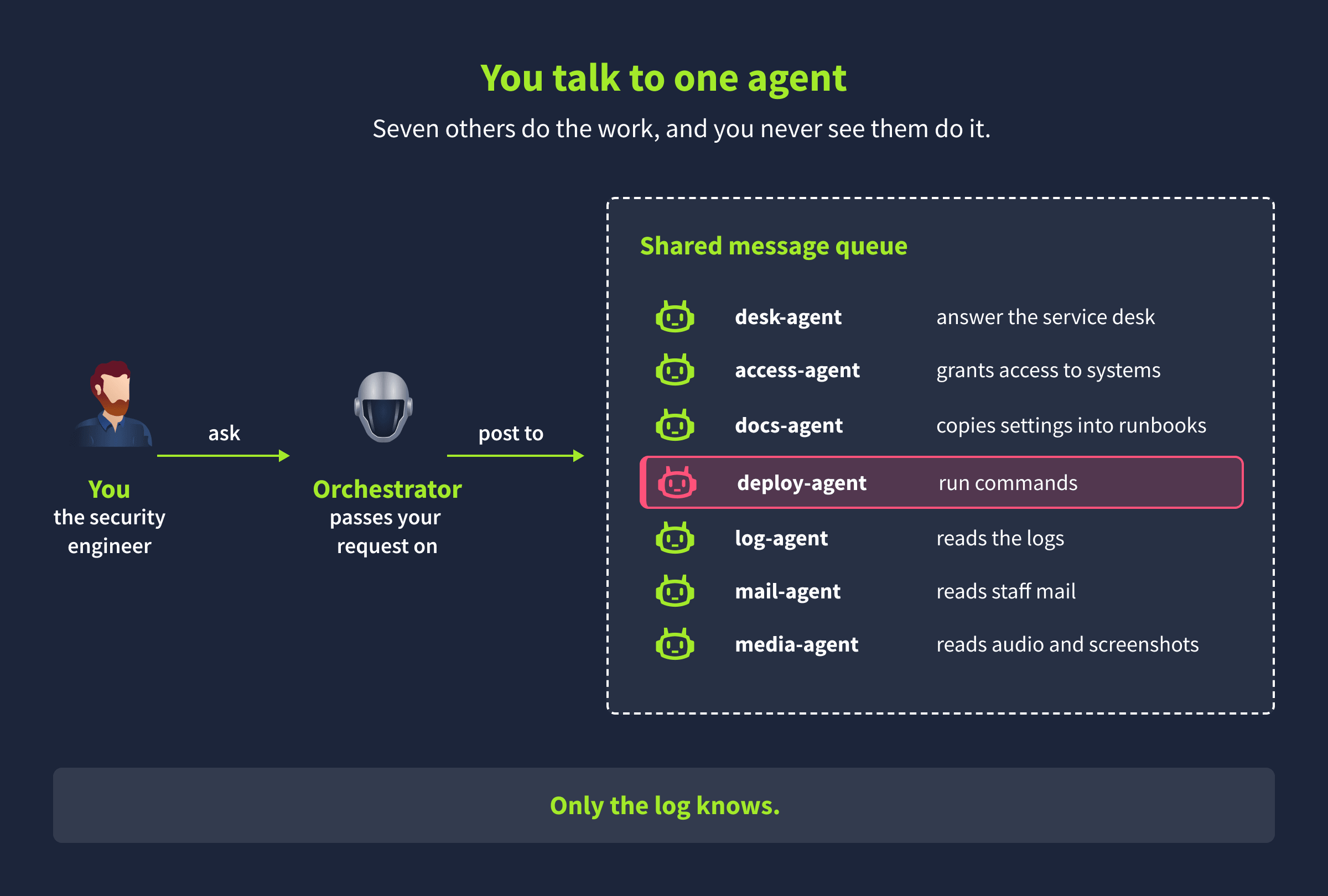
You talk to the orchestrator, which hands requests to seven specialist agents. deploy-agent is highlighted because it is the one that can run commands.
An Overnight Repair
This room follows an overnight repair where a build step failed at 03:14 on 4 August. deploy-agent read the error, wrote a fix, and ran it, because it had permission to. The build succeeded seconds later and nobody was alerted.
Learning Objectives
- Trace code an agent wrote from the moment it was composed to the moment it ran
- Identify the four routes by which an agent comes to run unreviewed code
- Explain why a reviewed manifest and a correct command allowlist both miss code written at runtime
- Name the control that closes each route
Prerequisites
- AI and fundamentals: How models are trained, served, and consumed, as described in The Building Blocks of AI room.
- What an agent is, and what a tool call looks like: The reasoning loop, tools, and delegation, as described in the Agentic Fundamentals room.
- Reading an agent event log: What a guardrail line looks like, as described in the Agentic Security Monitoring room.
- Prompt injection: How untrusted text reaches a model, as described in the Prompt Injection room.
You don't need to write any code.
Answer the questions below
I'm ready to learn how unreviewed code reaches production.
Ready to learn Cyber Security?
The ASI05: Unexpected Code Execution room is only available for Premium or Max subscribers. Signup now to access more than 500 free rooms and learn cyber security through a fun, interactive learning environment.
Already have an account? Log in