

SOC Role in Blue Team
Discover security roles and learn how to advance your SOC career, starting from the L1 analyst.
easy
30 min
127,189


To access material, start machines and answer questions login.
Introduction
You've learned about a L1 analyst role in the Junior Security Analyst Intro room. But where is it placed in a company structure? Who is overseeing your team? What other security departments exist? Which skills do you need to advance through your career ladder? Let's find out!
Learning Objectives
- Understand the concept and purpose of the
- Explore a place of the within the company structure
- Find out about your career path as a L1 analyst
Prerequisites
- Complete the Junior Security Analyst Intro room
- Remind yourself of Roles and Processes
Let's find out!
Security Hierarchy
Cyber security priorities are different for every company. For law firms, the goal is the privacy of the legal documents. For factories, the availability of production lines. For hospitals, patient safety. That's why every company has a unique security approach and security team structure. Let's take a look at the high-level example of it:
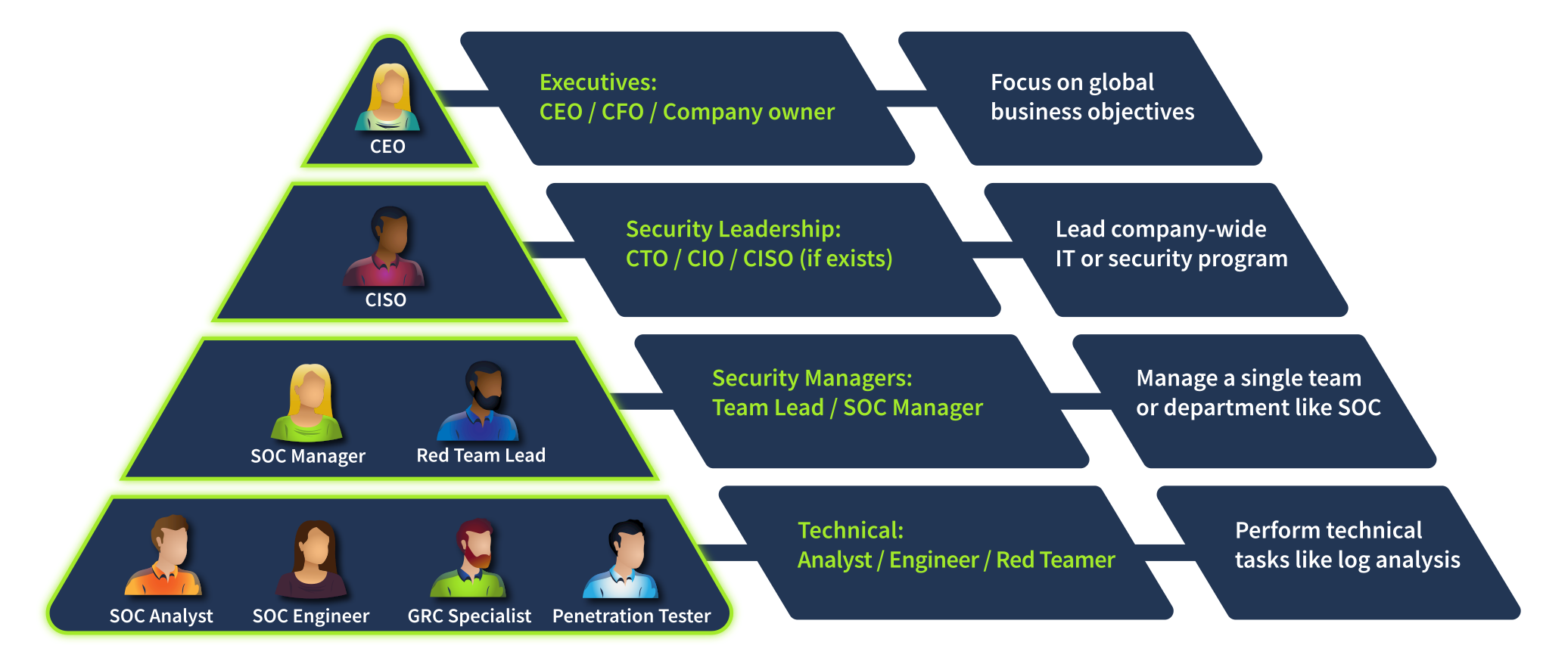
Looking at the diagram above, top executives like the CEO usually focus on global business objectives and don't manage technical aspects. That's why they hire a Chief Information Security Officer (CISO) or a similar role who knows the business needs and can create the most suitable security departments.
Security Departments
In tiny companies, the IT department takes the role of securing the company. Small to medium-sized companies may have a generic "Information Security" team that does all sorts of tasks. For this room, we will focus on bigger companies with a CISO overseeing multiple security teams, each handling a specific task. For example:
- Red Team: Offensive security experts, pentesters, or ethical hackers who look for security issues
- GRC Team: Specialists managing policies and ensuring compliance with regulations like (opens in new tab)
- : Defensive security experts like analysts, engineers, or incident responders
Which senior role typically makes key cyber security decisions?
What is the common name for roles like SOC analysts and engineers?
is about defensive security, meaning it constantly monitors for attacks and tries to respond to them quickly. Depending on a company's size and sector, can include a lot of different roles and subdepartments, usually counting 3 to 50 members total. Now, let's explore the most common departments.
Security Operations Center ()

That's where you are most likely to start your cyber security journey! is the central hub for an organization's cyber security - they are the first line of defense, work with various alerts, and handle most attacks. You can read more about structure in this room, but an efficient is usually composed of the following roles:
- L1 Analysts: Junior members who triage alerts and pass complex cases to L2
- L2 Analysts: Experienced members who investigate more advanced attacks
- Engineers: Experts in configuring security tools like or
- Manager: A person who manages the whole team
Cyber Incident Response Team (CIRT)

If expertise is not enough or the incident goes out of control, you urgently call the "firefighters" - CIRT, also called CSIRT or CERT. The members should have a broad knowledge of cyber threats and handle breaches without depending on tools like or . A CIRT job is stressful and responsible, but also rewarding. Here are a few CIRT examples:
- JPCERT (opens in new tab): Japan's CERT handling nation-wide breaches
- Mandiant (opens in new tab): A private team responding to global cyber incidents
- CIRT (opens in new tab): Investigates security incidents of customers
Specialized Defensive Roles

Large companies, technology-focused startups, and government agencies often require narrow and specialized roles - exciting and highly valuable, but requiring deep topic knowledge and broad experience in broader fields like or IT. These narrow roles can include:
- Digital Forensics Analyst: Uncover hidden threats in disk and memory
- Threat Intelligence Analyst: Gather data about emerging threat groups
- AppSec Engineer: Maintain a secure software development lifecycle
- Researcher: Study threats and how to defend against them
Does Blue Team focus on defensive or offensive security?
Which department handles active or urgent cyber incidents?
Path
Starting as a L1 analyst may be a great option to broaden your cyber world awareness and better understand the more specialized roles. Moreover, even the entry-level L1 role can be fun and engaging: You will deal with real attacks, protect the company from advanced threat groups, and learn a lot during the process. Let's see how you can start:
- Gain core skills and practice them. Related skills like red teaming or general IT would help, too!
- Be proactive, try yourself in CTFs, stay in the loop of cyber news, and consider the SAL1 certification!
- Prepare for an interview, learn the difference between an internal and MSSP, and apply for a job!
- After working for some time in a junior position, consider preparing and advancing to more senior roles!
Internal vs MSSP
Not every organization has the expertise to operate a on its own and relies on a Managed Security Services Provider (MSSP), a company that delivers outsourced security services, most commonly , to its clients. Working at MSSP is typically high-pressure, but it is also a good option to quickstart your career. While we recommend applying for any open position as your first job, it's also important to understand the differences:
| Topic | Internal | MSSP |
|---|---|---|
| Scenario Example |
You work in a team of the bank and protect the bank's systems | You work for a global MSSP protecting its sixty customers in Europe |
| Working Pace |
You usually have calm shifts without too much time pressure | Your shift usually starts from a queue of urgent alerts to analyze |
| Security Tools |
You work with just a few tools, but need to know them very well | You have to work with sixty diverse security tools and platforms |
| Incident Practice |
You saw and learned from just two major cyber attacks last year | Every week, you deal with attacks and breaches, and can learn from it |
Next Steps
Your most natural next step after L1 is to become a L2 analyst, but you are free to choose another path! While handling a alert, you might notice that engineering work appeals to you more. During a cyber attack, you may be fascinated by CIRT actions. You may also find yourself well-suited as a manager and build your path to the CISO role. No matter what, your first year or two is to get real work experience, and to spend this time effectively, follow the tips below!

How would you call a cyber security company providing SOC services?
Which role naturally continues your SOC L1 analyst journey?
Final Challenge
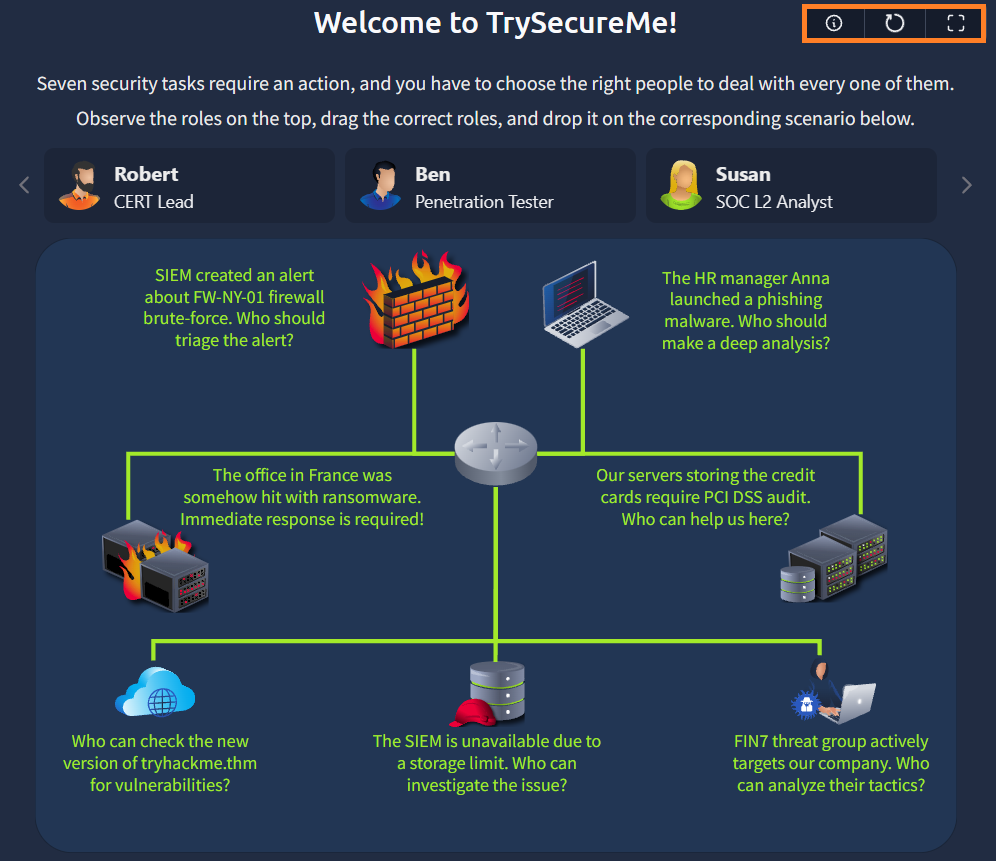
For this task, imagine yourself as a CISO of TrySecureMe, a big multinational company. You oversee multiple departments and deal with incidents every month. This time, as many as seven incidents are happening at the same time, and you have to choose the right people to deal with every one of them. Do you know security roles well enough to complete this challenge?
Website Instructions
Open the attached website by clicking the View Site button above and consider resizing or opening it in full screen for a better view. Then, drag and drop the roles from the left to the incidents on the right. If your choices are correct, claim your flag and complete the task! You can reset the website at any time by clicking the Reset button.
What flag did you claim after completing the final challenge?
Great job completing the challenge! Now you know how team works, where it is placed in the security structure, and what you need to do to start your career journey. Now, continue to the next rooms and learn what does actually protect: humans and systems.
Next Rooms in Path
Complete the room!
Ready to learn Cyber Security?
TryHackMe provides free online cyber security training to secure jobs & upskill through a fun, interactive learning environment.
Already have an account? Log in