

XSS2Shell: CVE-2026-64638

Chain a pre-auth XSS, DOM clobbering, and SOME to take control of a WordPress website and gain RCE.
medium

To access material, start machines and answer questions login.
WordPress (opens in new tab) powers a huge share of the web, and its login screen is one of the few pages every installation exposes to the entire internet, logged in or not. WordPress also ships a feature called Application Passwords: a way for an already-authenticated user to generate a scoped credential that lets an external app act on their behalf over the , no cookies required.
In August 2026, the security research team at pwn. (opens in new tab) disclosed a critical, pre-auth vulnerability chain in WordPress core, nicknamed XSS2Shell. A single, quietly reintroduced escaping gap on the login screen, combined with a legacy password-generator script never designed to run there, turns into full remote code execution the moment a logged-in administrator opens one crafted link. WordPress's own security release for 7.0.3 (opens in new tab) credits the same finding, and NVD tracks it as -2026-64638 (opens in new tab):
- Severity: High
- 4.0 Score: 8.9 (
AV:N/AC:H/AT:N/PR:N/UI:A/VC:H/VI:H/VA:H/SC:H/SI:H/SA:H) - CVE-ID: CVE-2026-64638
- CWE: CWE-79 (Improper Neutralization of Input During Web Page Generation)
- Affected Versions: All versions of WordPress before 7.0.3
- Patched Version: 7.0.3 (fix backported to every branch back to 4.7)

Info: Read the CVSS vector closely and it tells you the shape of the whole chain before you write a single payload. AC:H (high attack complexity) and UI:A (active user interaction) both point at a bug that cannot fire on its own; it needs a real person to do something. That "something" turns out to be a logged-in administrator simply opening a link, which Task 2 covers in full.
Consider a scenario where your organization runs a public WordPress blog with no unusual plugins installed, just a stock theme and core kept reasonably current. An attacker cannot log in, cannot guess a password, and cannot upload a file directly. All they have is a link. If a site administrator, already logged into /wp-admin in one browser tab, opens that link in another, the attacker walks away with a working shell on the server. No credentials were ever guessed, phished, or cracked.
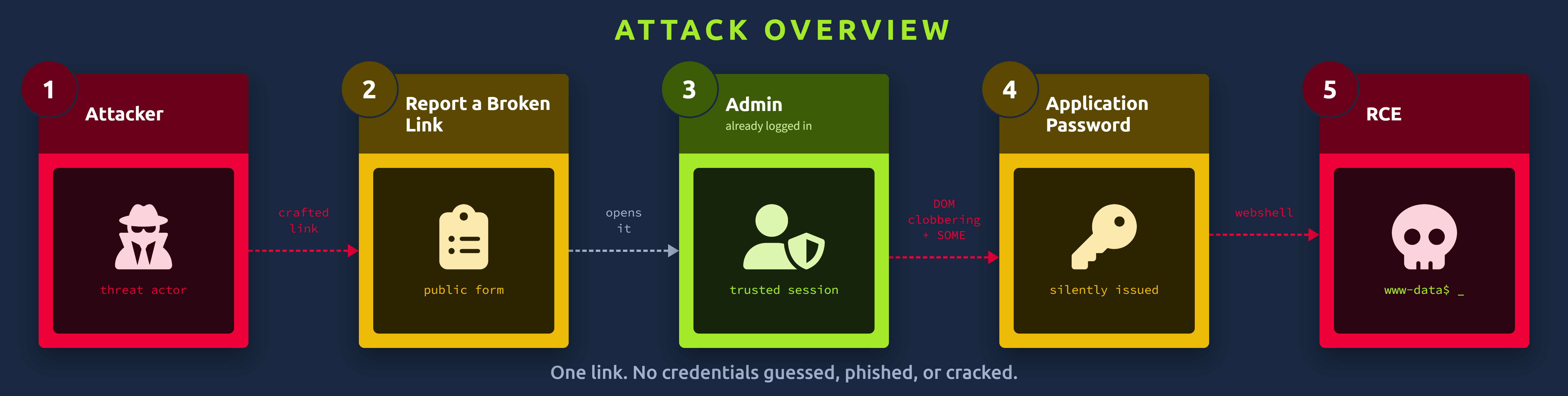
This room walks through the full chain: how a single space character defeats PHP's tag stripping without defeating WordPress's own HTML sanitizer, how that gap reaches a piece of legacy JavaScript nobody expected to run on the login page, and how that JavaScript hands an attacker a working webshell.
Learning Objectives
- Understand how a parser differential between
strip_tags()andwp_kses_post()lets malformed HTML survive - Understand DOM clobbering using HTML elements to override JavaScript variables
- Understand Same Origin Method Execution (SOME): using a JSONP-style callback
- Exploit WordPress's Application Passwords authorization flow to mint a credential without ever seeing the admin's real password
- Turn a stolen Application Password into remote code execution through the REST API
Prerequisites
Connecting to the Machine
Start the machine using the Start Lab Machine button below. Allow 2-3 minutes for it to fully load. Once ready, the will open in split view, providing access to both the lab environment and the required tools.
Set up your virtual environment

I have started the target machine.
Ready to learn Cyber Security?
The XSS2Shell: CVE-2026-64638 room is only available for Premium or Max subscribers. Signup now to access more than 500 free rooms and learn cyber security through a fun, interactive learning environment.
Already have an account? Log in