Becoming a Red Teamer
Red Teamers play the role of a simulated adversary, tasked with finding weaknesses in a system's defences. They conduct simulated attacks, often without prior knowledge of the system, to identify vulnerabilities that could be exploited by real attackers.
Their goal is to help organisations improve their security posture by revealing weaknesses and providing recommendations for mitigation.
Think of a red teamer as the James Bond of cyber security! They're the ultimate secret agents, but instead of saving the world, they're hacking into systems to find vulnerabilities before the bad guys do.
Before we get any further, there are several myths we want to dispel right away:
- I need a degree to become a Red Teamer
No, not true! We’ve learned from so many people who have launched their red teaming careers long after university—some have even studied something unrelated, while others never attended university at all. If this was ever a requirement, it’s definitely a thing of the past with the huge amount of content available to you online. - I need eight different certificates to show employers I’m ready
Again, this is not true! Employers want to see your mastery of the technical side, yes, but there are other ways to do this. For example, a portfolio of practical projects. Some examinations do include a practical component which is great, but they can also be expensive! - It’s too difficult to do alone
It may be difficult to do it alone, but with TryHackMe, you’ll never be alone! We have over 210,000 Discord members offering support, guidance, and inspiration. From careers advice to help with specific challenges, you’ll always get your questions answered fast.
So what are you waiting for?
Read on as we break down each of the steps to becoming a Red Teamer and kickstarting your career!

What is a Red Teamer?
Red Team Engineers (commonly known as Red Team Operators) are critically important in exploring the tactics, techniques, and procedures attackers use to infiltrate IT systems and stay under the radar in covert operations.
Mimicking the bad guys, Red Teamers pose as cyber criminals and emulate malicious attacks to test security and detect vulnerabilities. Red Teamers play crucial roles, as their operations place organisations as close to a real security incident as possible to accurately test incident response.
Red teams must maintain oversight of blue team actions in order to gain visibility of both threat and defence strategies. This rule also applies to blue teams, who should understand how offensive security works and how attackers go about this to arm the defence.
Initially, a Red Teamer may start as an entry-level, Penetration Tester, tasked with conducting basic security assessments and vulnerability scans.
Along the way, you'll have the opportunity to collaborate with fellow red teamers, share knowledge, and contribute to the collective mission of safeguarding digital assets.
With further experience, a Red Teamer might specialise in particular areas such as network penetration testing, web application security, or social engineering. They may also develop expertise in using advanced tools and techniques, such as exploit development or reverse engineering.
The day-to-day responsibilities of a Red Teamer typically involve simulating cyber attacks to identify and exploit vulnerabilities in an organisation's systems and infrastructure. This includes tasks such as conducting penetration tests, performing vulnerability assessments, researching new attack techniques, developing custom exploits, and collaborating with blue team defenders to improve overall security posture.
Why become a Red Teamer?
There are many reasons to become a Red Teamer - delving into new challenges, fantastic job satisfaction, incredible career opportunities, and a competitive salary to compensate!
- As a Red Teamer, you'll delve into the exhilarating world of ethical hacking, where every challenge presents an opportunity to outsmart adversaries and fortify defences. With hands-on experience in simulating real-world cyberattacks, you'll develop a keen eye for identifying vulnerabilities and crafting innovative solutions to protect against them.
- You'll embark on a journey of continuous learning and discovery, honing your skills in penetration testing, exploit development, and threat emulation.
- Embrace the excitement, the adrenaline, and the satisfaction of knowing you're not just defending systems – you're shaping the future of cyber security!
Is a Red Teamer role a suitable fit for me?
Are you fascinated by the strategic artistry of cyber operations? Are you driven by the pursuit of uncovering vulnerabilities and pushing boundaries?
If you answered yes to these questions, the Red Teaming career path might be just right for you.
If you enjoy problem-solving, have a strong technical background in cyber security, and thrive in a dynamic, fast-paced environment, then a Red Teamer role could be a great fit!
If you answered yes to these questions, the Red Teaming career path might be just right for you.
If you enjoy problem-solving, have a strong technical background in cyber security, and thrive in a dynamic, fast-paced environment, then a Red Teamer role could be a great fit!
- Technical Proficiency - A strong foundation in cyber security fundamentals, including networking, operating systems, and common security tools, is essential. Red teamers should also be proficient in offensive security techniques, such as penetration testing, exploit development, and social engineering
- Critical Thinking - Red teamers must be able to think outside the box, anticipate adversary tactics, and creatively approach challenges. They should be able to analyse complex systems, identify vulnerabilities, and devise innovative solutions to exploit them..
- Attention to Detail - Red teamers must be meticulous in their work, paying close attention to every detail to uncover even the smallest security weaknesses. They should possess a keen eye for identifying anomalies and inconsistencies within target environments.
- Adaptability - Cyber threats are constantly evolving, so red teamers need to be adaptable and agile in responding to new challenges. They should be comfortable learning new techniques, tools, and methodologies to stay ahead of emerging threats.
- Communicative - Effective communication is key for red teamers to convey their findings, recommendations, and potential risks to stakeholders clearly and concisely. They should be able to articulate complex technical concepts to both technical and non-technical audiences.
Learn from a Pro:
Tinus Green
“I encourage all of our new team members to make use of TryHackMe to learn red team content for a couple of reasons. Firstly, the content provided by TryHackMe is hands-on practical content that teaches them real-life red teaming skills and concepts. Secondly, the red team content teaches foundational skills that can be applied with any of the current industry tools and trends. Lastly, TryHackMe does not just provide red team content but blue team, security engineering, and application security content, intrinsically helping to make them better by understanding the other side.”
Skills for a Red Teamer
As a Red Teamer, you will be responsible for simulating real-world cyberattacks to identify vulnerabilities and weaknesses in our organisation's systems, applications, and infrastructure. Working closely with the blue team defenders, you will leverage offensive security techniques, including penetration testing, vulnerability assessment, exploit development, and social engineering, to assess and improve our security posture.
Vulnerability & WeaknessesConduct simulated cyber attacks to identify security vulnerabilities and weaknesses in systems, applications, and networks.Red Team EngagementsDevelop and execute red team engagement plans, including reconnaissance, exploitation, and post-exploitation activities.Detect and ResponseCollaborate with blue team defenders to assess and improve detection and response capabilities.Incident Response TestingParticipate in tabletop exercises and incident response simulations to test and validate cyber security incident response plans.Research & UpskillingResearch emerging threats, vulnerabilities, and attack techniques to stay ahead of evolving cyber threats.ReportingDocumenting findings, testing methodologies, and recommended remediation actions in clear and detailed reports.
Required Skills:
Cyber Security FundamentalsA strong understanding of core cyber security concepts, including networking, operating systems, cryptography, and common attack vectors, is essentialOffensive Security TechniquesProficiency in offensive security techniques, such as penetration testing, vulnerability assessment, exploit development, and social engineering, is crucial for simulating real-world cyber attacks.Tool ProficiencyFamiliarity with a variety of security tools and frameworks is important, including network scanning tools, exploitation frameworks, password cracking tools, and wireless hacking tools.Scripting and ProgrammingKnowledge of scripting languages like Python, PowerShell, and Bash is valuable for automating tasks, developing custom tools, and manipulating systems during red team engagements.Operating SystemsProficiency in various operating systems, including Windows, Linux, and Unix, is necessary for understanding their security mechanisms, vulnerabilities, and configurations.Reverse EngineeringBasic understanding of reverse engineering techniques and tools is beneficial for analysing malware, understanding exploit payloads, and identifying vulnerabilities in software and firmware.Critical Thinking and Problem-SolvingStrong analytical skills, the ability to think creatively, and a knack for identifying and exploiting security weaknesses are essential for success as a red teamer. such as Certified Ethical Hacker (CEH), Offensive Security Certified Professional (OSCP), or related credentials are advantageous.Communication SkillsEffective verbal and written communication skills are necessary for conveying findings, recommendations, and potential risks to stakeholders in a clear and concise manner.AdaptabilityRed teamers must stay abreast of the latest cyber security trends, tools, and techniques, and be adaptable in responding to new challenges and emerging threats.
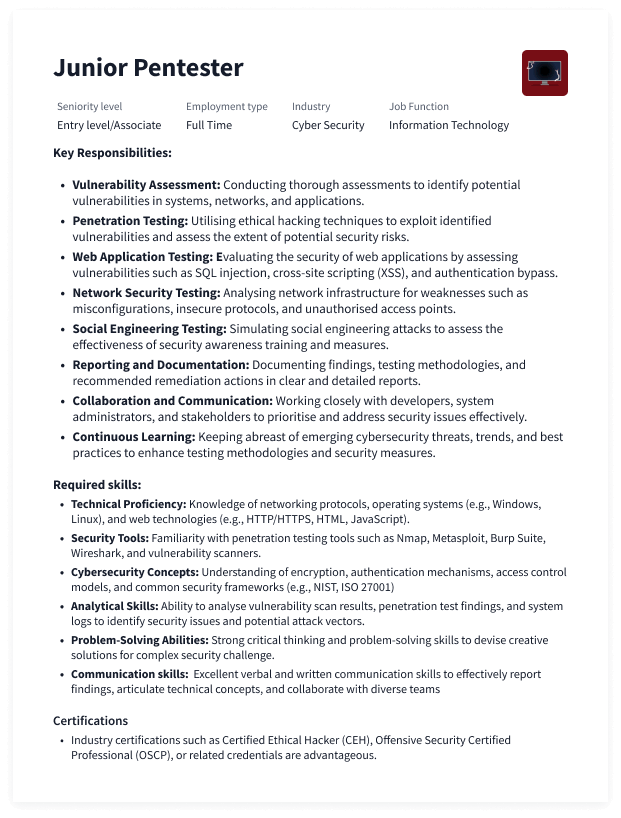
Check out the example job description for a Penetration Tester below!
What do I need to become a Red Teamer?
Want to learn how to become a Red Teamer? Well, TryHackMe gives you the educational foundation to pursue a career as a Red Teamer.
In fact, we have a Red Teaming learning path dedicated to this role, including other paths to help you get there, such as our Jr Penetration Tester, and Offensive Pentesting paths. That’s dozens of hours of content designed to get you your first job and help you progress your career.
With our platform, you’re on the right path to becoming a Red Teamer. You'll learn how to conduct successful Red Team engagements, challenge your clients' defence capabilities, and emulate a potential adversary attack in complex environments.
After completing our Red Teaming learning path, we recommend checking out our Red Team Capstone Challenge Network - the milestone challenge for offensive security professionals and aspiring Red Teamers. By simulating what you would typically find in a real client engagement, what you would typically find in a real client engagement, allowing you to apply your knowledge and put your skills to the test! As the largest and most comprehensive network created by TryHackMe, there are 20 flags to collect, spread across 10 different phases.
Or, if you’re starting with zero technical knowledge, we have entire learning paths dedicated to getting you ready: try our Pre-Security or SOC Level 1 paths first, before taking on the Red Teaming learning path!
0 to 1 with TryHackMe
Don’t just take our word for it! Over to you, David:
I was just going through some very tough SQL Injection Lab a couple of weeks ago and I couldn’t solve it. And then I realised that’s probably because I don’t have the basics as solidified as I think I do. So I went back, I went to TryHackMe, and I just did a bunch of TryHackMe rooms on SQL. And some of those were pretty easy, some were intermediate, and getting that information again really made a difference for me. For me, as a Penetration Tester with 5 years of experience, knowing there’s a platform where I can go back and get all that information again is so very useful.
Even the pros find reasons to come back to TryHackMe!
Seeking a Red Teamer role? Here’s everything to know!
Now that you have the skills and know the demands of the role, it’s time to see what’s out there.
While you can dive right into a job board and start looking for Red Teamer roles, there are a few things to consider first.Work/Life Balance:Red teaming often involves irregular hours, especially during active engagements or incident response situations. Consider whether you're comfortable with potential on-call responsibilities and the occasional need for extended work hours. Of course, maintaining a healthy work/life balance is essential for long-term well-being and job satisfaction!Time Management:Red teamers often work on multiple projects simultaneously, each with its own deadlines and priorities. Effective time management skills are crucial for juggling tasks, meeting deadlines, and maintaining productivity. Consider whether you have the ability to prioritise tasks, manage your workload efficiently, and adapt to changing priorities as needed.Continuous LearningCyber security is a rapidly evolving field, with new threats, vulnerabilities, and technologies emerging constantly. Red teamers need to stay up-to-date with the latest developments in cyber security and continuously refine their skills to remain effective in their roles. Consider whether you have a passion for learning and a commitment to staying current with industry trends, tools, and techniques.Job MarketResearch the job market's demand for red teamers and the availability of opportunities in your desired location or industry. Assess factors such as job prospects, salaries, and benefits to ensure they meet your expectations.
Get the Job!
You’ve decided a Red Teamer career is right for you and you’ve completed our Red Teaming learning path. What now?
If you feel like you’re ready, it’s time to take the leap and begin applying for roles! Believe us when we say this - with TryHackMe, you’re in great hands, and in the best possible place to secure a Red Teaming role!
Before applying for roles, we suggest checking out our Red Team Capstone Challenge Network— the milestone challenge for offensive security professionals and aspiring Red Teamers. The capstone challenge simulates what you would typically find in a real client engagement, allowing you to apply your knowledge and put your skills to the test!
And if you feel you’re still not quite there, no problem! We have hundreds of training rooms to expand your knowledge. If you’d prefer to get a little experience under your belt first, we have plenty of tips for gaining hands-on experience gathered by industry professionals who were once in your shoes!
Share

Red Teamer
Learn the practical skills required to start your career as a professional Red Teamer.